

India’s solar journey is powering its emergence as a global clean energy leader. As the founding member and host of the International Solar Alliance (ISA) headquarters in Gurugram, India has championed solar energy deployment, finance, and technology transfer across more than 125 member nations. In October 2025, India hosted the 8th ISA Assembly in New Delhi, bringing together ministers and delegates worldwide to advance strategies for resilient solar value chains, inclusive access, and accelerated adoption of solar energy.
The surge in solar installations over the past decade has played a pivotal role in doubling India’s total installed electricity capacity. Presently, solar capacity stands at 129 GW, while the non-fossil electricity capacity has crossed 259 GW, accounting for over 50 % of the nation’s total installed power capacity as of October 2025, marking a historic shift toward low-carbon energy.
By coupling rapid domestic deployment with global collaboration, India is laying the foundation for a resilient, sustainable, and solar-powered energy future that sets benchmarks for the world.
Driving the Green Transition: India’s roadmap under Panchamrit Framework
Rapid progress in renewable energy expansion is driven not only by market momentum but also by a robust policy and strategic framework. National targets and global climate commitments, outlined under the Panchamrit Declaration at COP26 in Glasgow (November 2021), provide a clear roadmap for a sustainable energy future.
The five key components of the Panchamrit framework are as follows:
• 500 GW of Non-Fossil Fuel-Based Installed Electricity Capacity by 2030– Encompassing solar, wind, biomass, hydro, and nuclear energy, this target aims to substantially increase the share of clean energy in India’s electricity mix.
• 50% Share of Installed Electricity Capacity from Non-Fossil Sources by 2030 – Designed to diversify the energy portfolio and reduce dependence on fossil fuels.
• Reduction of Total Projected Carbon Emissions by 1 Billion Tonnes by 2030 – Reflecting India’s commitment to mitigate greenhouse gas emissions through cleaner energy and enhanced efficiency measures.
• Reduction of Carbon Intensity of the Economy by 45% by 2030 (compared to 2005 levels) – Promoting energy efficiency, low-carbon technologies, and sustainable industrial practices.
• Net Zero Emissions by 2070 – A long-term goal aimed at balancing emissions with carbon removal, ensuring sustainable development.
India’s Solar Surge: A Remarkable over 40-fold increase
The solar sector has expanded at an unprecedented pace over the past decade, growing from just 3 GW in 2014 to 129.92 GW by October 2025—a remarkable over 40-fold increase. This rapid growth has made solar the largest contributor to the renewable energy portfolio, surpassing wind, hydro, and biomass capacities.
The surge in solar capacity is driving a steady increase in the share of renewable energy in the overall power mix. These achievements underscore India’s commitment to a low-carbon energy transition and highlight the pivotal role of solar energy in building a resilient, sustainable, and secure electricity system.
India’s standing in Global Renewable Energy
According to the IRENA Renewable Energy Statistics 2025, India ranks:
• 3rdin solar energy
• 4th in wind energy, and
• 4th globally in total installed renewable energy capacity
These rankings underscore India’s growing influence in global clean energy markets and its pivotal role in advancing affordable, accessible, and sustainable energy for all.
Policy in Action: Accelerating India’s Solar Ambitions
India’s commitment to achieving net-zero emissions is being translated into action through a series of large-scale government programmes. These initiatives are designed to accelerate renewable energy adoption, promote sustainable living, and strengthen India’s clean technology ecosystem.
PM Surya Ghar
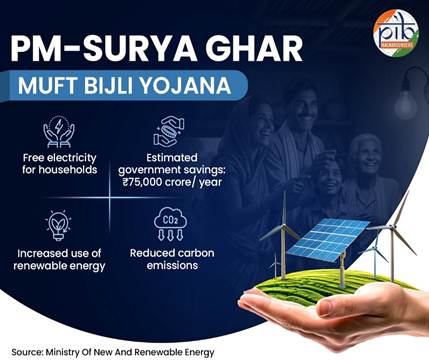
PM Surya Ghar mission is one of the central pillars of India’s push toward renewable energy and net‑zero emissions. Launched on 13 February 2024 with a Cabinet approval, the scheme has a total outlay of ₹ 75,021 crore. Its aim is to provide rooftop solar systems to one crore households, providing up to 300 units of free electricity every month.
The scheme encourages the adoption of renewable energy sources, supporting the commitment to India’s commitment to reduce its carbon footprint. With 22.65 Households Benefitted with rooftop solar installations already completed as of March 2025, the scheme is well on track to achieve its ambitious goal of 1 crore solar-powered homes.
National Solar Mission
Launched in January 2010, the National Solar Mission (NSM) is a flagship initiative of the Government of India aimed at promoting the large-scale deployment of solar energy across the country. The mission plays a key role in achieving India’s renewable energy targets and its commitment to a low-carbon future.
Driven by policy support under the NSM and complementary initiatives, solar energy capacity has witnessed exponential growth over the past decade. The sector’s growth has been driven by a diversified portfolio of solar technologies, including:
• Ground-Mounted Solar Power Plants: 98.72 GW
• Grid-Connected Rooftop Solar Systems: 22.42 GW
• Hybrid Solar Projects (solar component only): 3.32 GW
• Off-Grid Solar Systems: 5.45 GW
This progress demonstrates India’s continued leadership in renewable energy deployment and aligns with its broader goal of achieving 500 GW of non-fossil fuel-based electricity capacity by 2030, as committed under the Paris Agreement and reiterated at COP summits.
Production-Linked Incentive (PLI) Scheme for Solar PV
The Ministry of New and Renewable Energy (MNRE), Government of India is implementing the Production Linked Incentive (PLI) Scheme under the National Programme on High Efficiency Solar PV Modules to achieve Giga Watt (GW)-scale manufacturing capacity in high-efficiency solar PV modules, with a total outlay of ₹ 24,000 crore, to promote domestic manufacturing of high-efficiency solar PV modules and reduce import dependence. The scheme offers incentives for five years post-commissioning based on actual sales and efficiency performance, with selection through a transparent process. It is being implemented in two tranches—Tranche I (₹4,500 crore, approved April 2021) and Tranche II (₹19,500 crore, approved September 2022)—with Letters of Award issued for setting up 48,337 MW of integrated and partially integrated manufacturing capacity.
Did you know?
As of September 2025, the PLI scheme for solar PV has attracted ₹52,900 crore in investment and generated around 44,400 jobs. The PLI amount is linked to local content, encouraging development of a robust solar PV ecosystem, promoting advanced technology, and strengthening India’s energy self-reliance.
As of June 2025, the scheme has attracted ₹48,120 crore in investment and generated around 38,500 jobs. The PLI amount is linked to local content, encouraging development of a robust solar PV ecosystem, promoting advanced technology, and strengthening India’s energy self-reliance.
PM-KUSUM Scheme
Launched in 2019, the Pradhan Mantri Kisan Urja Suraksha evam Utthaan Mahabhiyan (PM-KUSUM) scheme promotes solar energy use in agriculture by enabling farmers to become energy producers. The scheme consists of three components:
• Component A: Installation of small grid-connected renewable energy plants on barren or fallow land.
• Component B: Installation of standalone solar pumps in areas with limited grid access.
• Component C: Solarisation of existing grid-connected agricultural pumps, allowing farmers to feed surplus power into the grid.
As of 2025, over 19 lakh pumps have been installed/solarized, benefiting more than 9.2 lakh farmers nationwide with standalone solar pumps. The government provides Central Financial Assistance (CFA) of 30%, enhanced to 50% in North-Eastern, hilly, and island regions under Components B and C to make adoption more affordable.
Solar Parks & Ultra-Mega Solar Power Projects
The Development of Solar Parks and Ultra-Mega Solar Power Projects Scheme was launched in December 2014 by the Ministry of New and Renewable Energy (MNRE) with an initial target of 20 GW, later enhanced to 40 GW in March 2017. As of 31st October 2025, 55 solar parks with a combined sanctioned capacity of 39,973 MW approved across 13 states. A total of 14,922 MW capacity of solar projects has already been installed in these Parks and the balance are under various stages of implementation.
The scheme has been extended until 31st March 2029 for completion of all approved solar parks. These parks facilitate development of shared infrastructure like acquisition of land, power evacuation systems, road, and water facilities etc., for large-scale deployment of solar power projects.
Solar Synergy: India Leading International Alliances for Solar Energy
India has firmly established itself as a global leader in clean energy and climate action, actively contributing to the international agenda through strategic partnerships and innovation. As a founding member of Mission Innovation and the Clean Energy Ministerial, India co-leads critical initiatives focused on Smart Grids, sustainable biofuels, and off-grid electrification, reflecting its commitment to global clean technologydeployment.
At COP26 in Glasgow (November 2021), India unveiled the Panchamrit framework, including a commitment to achieve net-zero emissions by 2070, earning global recognition for its climate leadership. India has already surpassed its 2030 target of 50% of electricity capacity from non-fossil based sources five years early, reinforcing its position as a global clean energy leader.
A cornerstone of India’s international engagement is its leadership in solar energy through strategic alliances such as the International Solar Alliance (ISA), co-founded with France.
Headquartered in Gurugram, ISA is an inter-governmental organization dedicated to mobilizing global investments in solar energy, promoting deployment, technology transfer, finance aggregation, and capacity-building across member nations. The 8th Assembly of the ISA, held in New Delhi in October 2025, brought together ministers and delegates from over 125 countries to discuss strategies for accelerating global solar adoption. The Assembly reaffirmed collective commitments to advancing solar finance, resilient supply chains, and inclusive access to affordable renewable energy, underscoring India’s pivotal role in shaping the global solar agenda.
ISA 8th Assembly – Key Highlights
⦁The 8thAssembly of the International Solar Alliance (ISA) convened in New Delhi from October 27 to 30, 2025.
⦁ Over 550 delegates and 30+ ministers from 125+ Member and Signatory countries convened under India’s presidency.
⦁ President Droupadi Murmu highlighted that solar energy is about empowerment and inclusive development, not just power generation.
⦁ Inclusive agenda launched ensuring that no woman, no farmer, no village and no small island is “left behind” in the solar revolution.
⦁ Reinforcement of the “One Sun, One World, One Grid” vision alongside emphasising job creation, rural livelihoods, women’s leadership and digital inclusion as metrics of success.
⦁ Defined four strategic pillars: Catalytic Finance Hub, Global Capability Centre & Digitisation, Regional & Country Engagement, and Technology Roadmap & Policy.
Complementing this, the One Sun, One World, One Grid (OSOWOG) initiative, proposed by Prime Minister Narendra Modi in 2018, focuses on interconnecting renewable energy grids across countries. By enabling solar-rich regions to supply power globally, this initiative aims to create a transnational renewable-energy network that promotes energy security and sustainability.
These achievements have earned India growing international recognition for its climate leadership and balanced development approach.
The G20 New Delhi Leaders’ Declaration (2023) acknowledged the importance of promoting “Lifestyles for Sustainable Development (LiFE)” and appreciated India’s leadership in advancing climate and environment priorities. Similarly, the International Energy Agency (IEA) has described India as “a major driving force in global energy trends,” noting that the world’s energy future “cannot be planned without India at the table.” Together, these affirmations underscore India’s pivotal role in shaping the global clean-energy transition and promoting sustainable, inclusive growth.
Conclusion
India’s solar journey exemplifies how targeted policy, technological innovation, and strategic collaboration can transform a nation’s energy landscape. Solar energy has not only become the backbone of India’s renewable power mix but also a catalyst for sustainable economic growth, energy security, and climate leadership. By combining large-scale deployment with global partnerships through the International Solar Alliance and initiatives like OSOWOG, India is demonstrating that solar power can be both a domestic solution and a driver of global clean energy progress.
As India continues to expand its solar capacity, foster innovation, and enable inclusive access, it is charting a clear path toward a resilient, low-carbon future—showing the world that solar energy is central to achieving both national and global climate ambitions.