
Goa’s culinary heritage is thinning out under the pressure of tourism and shifting urban tastes, according to experts. And while the erosion is slow, the fading footprint is extremely evident, with salt pans drying up, everyday aromas fading from neighbourhoods and old food knowledge slipping into the cracks of modern, modular kitchens.
At this year’s Serendipity Arts Festival, four culinary curators, Thomas Zacharias, Prahlad Sukhtankar, Odette Mascarenhas and the duo behind Edible Issues, Anushka Murthy and Elizabeth Yorke, attempt to hold the line by turning the festival into a living archive of what Goa still remembers and more importantly, what it risks forgetting.
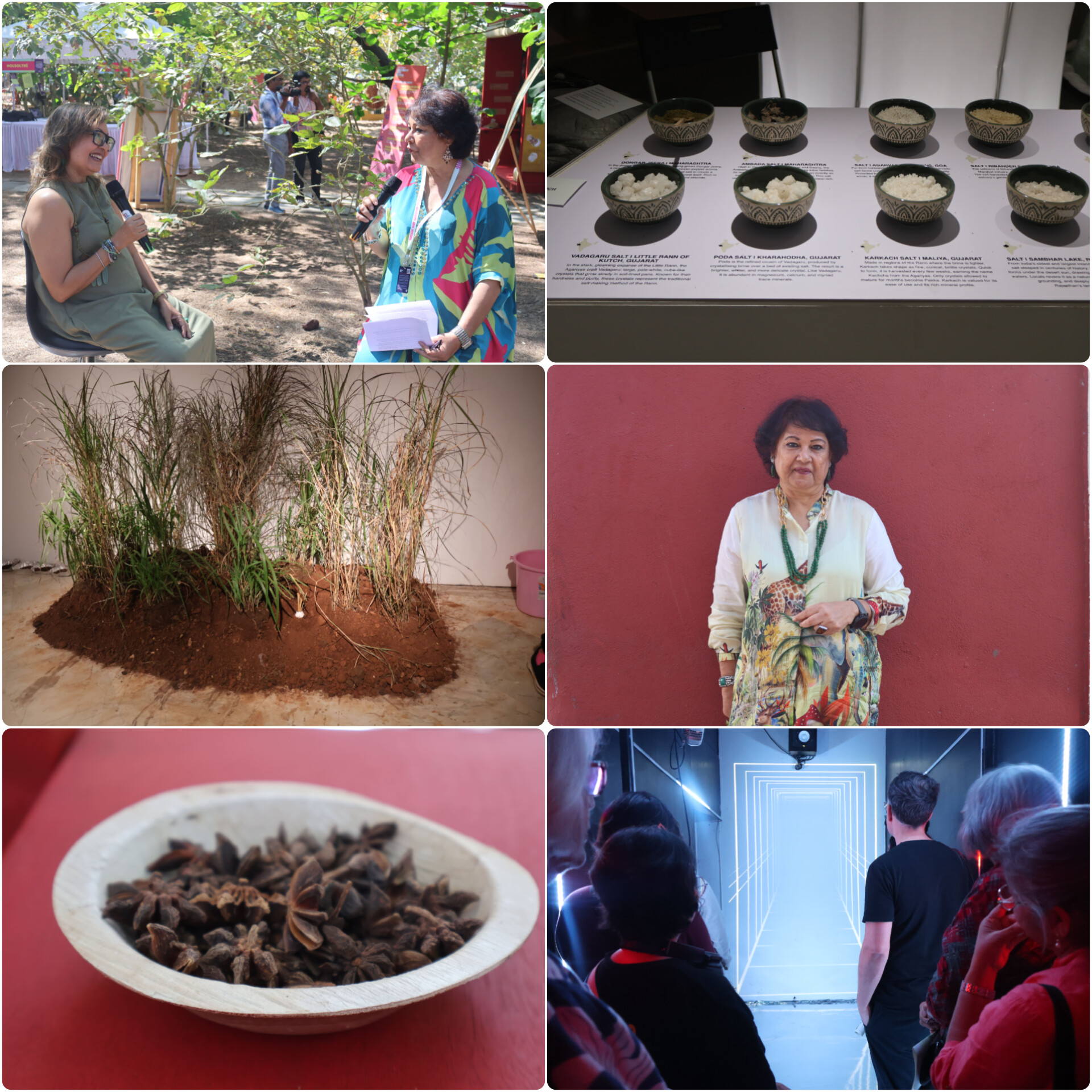
Chef Prahlad Sukhtankar’s project, ‘Salt’, confronts one of the state’s most visible disappearances. Once more than 75 salt pans dotted the state. Today, he says, “We barely have five main areas of salt production.” Generational loss and land-use changes are steadily erasing a craft that shaped Goa’s khazan landscapes for centuries. His exhibition also widens the lens: India once had around 130 indigenous salts; “only about 30 or 35 are available now,” he notes. His team could source just 18 for the exhibition. Goa’s own marine salts stand apart for their “brininess” and the way “you smell the ocean in the salt,” a sensory signature that inland salts cannot replicate, Sukhtankar said.
If salt marks what is disappearing from the ground, Anushka Murthy and Elizabeth Yorke’s ‘Smell Rooms’ track what is vanishing from the air. They attempt what may be Goa’s first olfactory food-heritage archive, mapping the state through scents that once defined neighbourhood life. “We asked people what changed in ten years,” Yorke says. “A common thing was how we used to fry fish and you’d know which neighbour is cooking what. That smell has faded.”
In a Goa increasingly moving towards air-conditioning, sanitised kitchens and rapid construction, smell becomes memory, one that also needs to be captured before it too disappears.
For chef Thomas Zacharias and The Locavore, the question is poignant: What does loss taste like? His installation imagines an India in 2100, where ingredients, traditions and food diversity have thinned to the point of absence. “Either food traditions are dying or there’s loss at the farm level,” he says. The project is in collaboration with Immerse and Quasar Thakore Padmasee.
The culinary curator, Odette Mascarenhas, turns the gaze back to Goa’s kitchens, excavating pre-chilli culinary histories across five communities — Hindu artisans, Gaud Saraswat Brahmins, Muslim families, Christian kitchens and Indo-Russo homes. Her challenge was simple: cook Goan food without chillies. “It shows what the cuisine looked like before the Portuguese,” she says. But her findings extend beyond spice. Everyday dishes once cooked at home are fading from public spaces, she says, pointing out how tourism and urban tastes have nudged authentic Goan cooking to the margins.
Together, the four curators turn Serendipity’s culinary section into something more than a showcase. It becomes a ledger of what Goa stands to lose — and what might still be reclaimed if the state listens closely.