
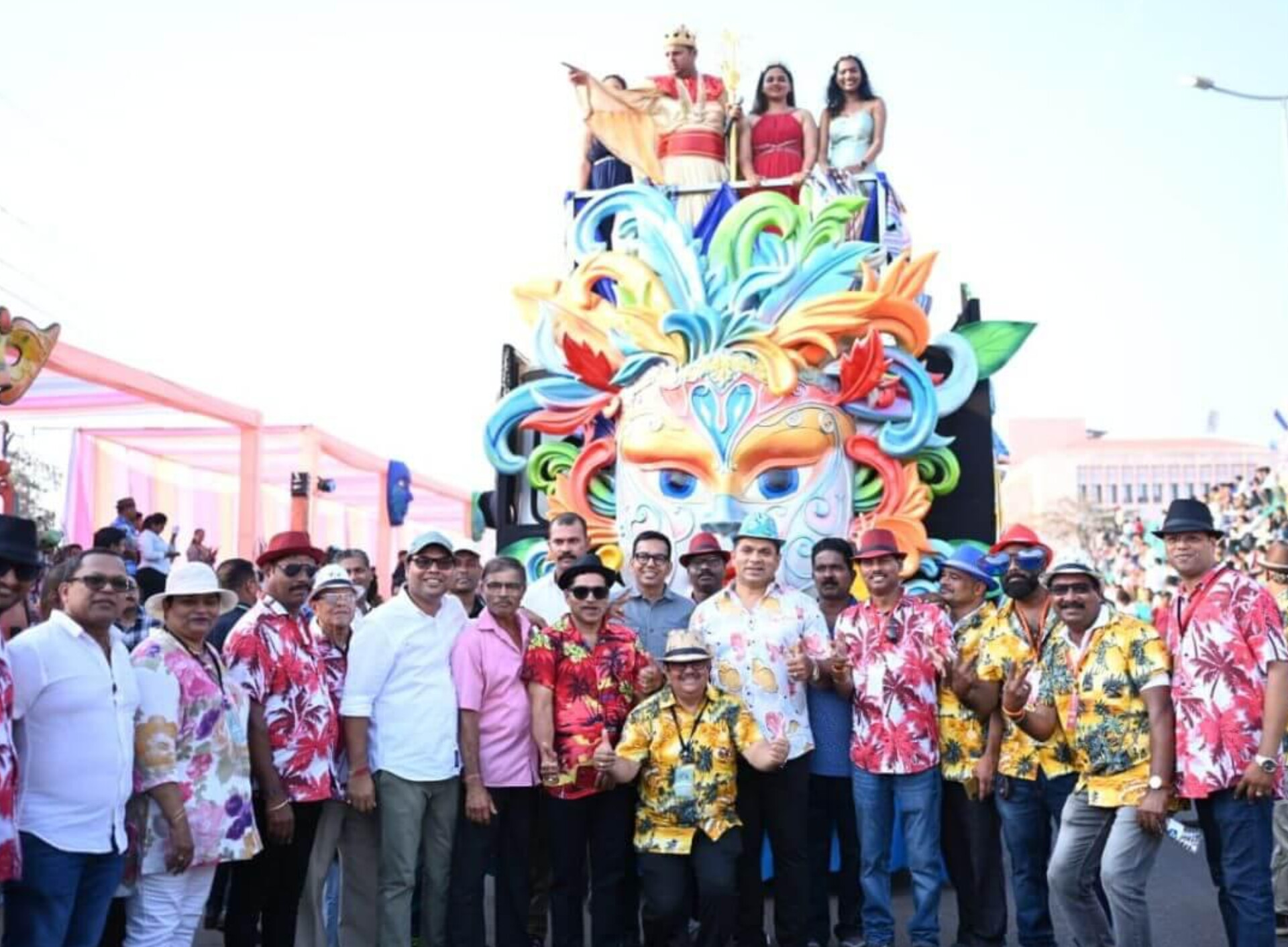
The Porvorim Carnival Committee announced the return of the People’s Carnival Parade 2026, a community-led, people-powered celebration that aims to revive the original spirit of Goa’s Carnival, where culture, creativity and public participation take precedence over spectacle.
The People’s Carnival Parade will be held on Thursday, 13 February 2026, from 3:30 pm onwards at Chhatrapati Shivaji Maharaj Marg, Art Park, Porvorim. The parade is built around a simple but powerful idea: No Engines, No Generators, Only Joy, reinforcing a return to Carnival as a walking, dancing, people-driven celebration like in the past.
Outlining the vision behind the initiative, Tourism Minister and local MLA, Rohan Khaunte said: “Carnival has traditionally been an expression of Goa’s social and cultural fabric, rooted in satire, music, humour and collective joy. Over the years, the increasing use of motorised floats, generators and excessive amplification has altered the character of the celebration. For the Goans who once enjoyed Carnival, there was nouch appeal. It is through initiatives such as the People’s Carnival Parade and people coming forward to help restore Carnival to its original form while keeping it inclusive, environmentally conscious and rooted in community participation that the revival will be seen starting with Porvorim.”
Reena Fernandes representing the organising committee in Porvorim stated: “The parade is designed as an open platform for citizens, families, institutions and performers to actively take part, rather than remain spectators. Early Bird incentives are being awarded in categories for their commitment to revive the past through some innovation.”
This year, a new precedent will be set with participation being strictly people-powered, with no motorised or fuel-driven vehicles, no generators and no large sound systems. Only acoustic and portable music will be permitted, encouraging creativity through costumes, storytelling, live music, dance and movement.
Committee members added that the People’s Carnival Parade has, over the years, evolved into one of Goa’s most distinctive Carnival initiatives by prioritising participation over performance and people over props.
“By removing engines, excessive noise and commercial floats that often lack meaning, this celebration aims to create space for interaction, cultural expression and genuine community bonding,” said Abigail D’Mello, who is playing a key role in overseeing participation and rules. “It reflects the Carnival many Goans remember and hope to pass on to future generations.”
The parade will feature people’s floats with a minimum of 20 participants, a family category with a minimum of four members, as well as individual performers including clowns and jokers.
Another member of the committee Martha Pinto emphasised how the People’s Carnival Parade 2026 will be a breath of fresh air. “Goans of the years have missed out on the cultural and traditional aspect of what Carnival used to be. Of course, it attracts tourism but there’s a need to safeguards what’s special to us Goans. It’s a good start and there has been a lot of positive response already,” Pinto said.
To encourage wider participation across age groups and communities, the People’s Carnival Parade 2026 features a structured prize scheme across multiple categories, including Traditional, Club/Institution, Family and Clown/Joker. Cash prizes will be awarded up to the fifth position in each category, along with consolation prizes, recognising creativity, cultural expression and collective effort rather than scale or spectacle.
In addition, an early bird incentive has been introduced, with the first 25 registered People’s Floats (minimum 20 participants) receiving ₹6,000 each, and the first 25 family entries (minimum four members) receiving ₹3,000 each, reinforcing the committee’s focus on early community engagement and people-led participation.
The event is open to all and invites citizens to walk, dance and celebrate together in a safe, inclusive and noise-free environment.
The People’s Carnival Parade 2026 continues this tradition by holding on to what Carnival has always stood for, while allowing it to grow with each new generation. Keeping it people-powered and inclusive ensures that Carnival remains something the community creates together, not just something to be watched.