

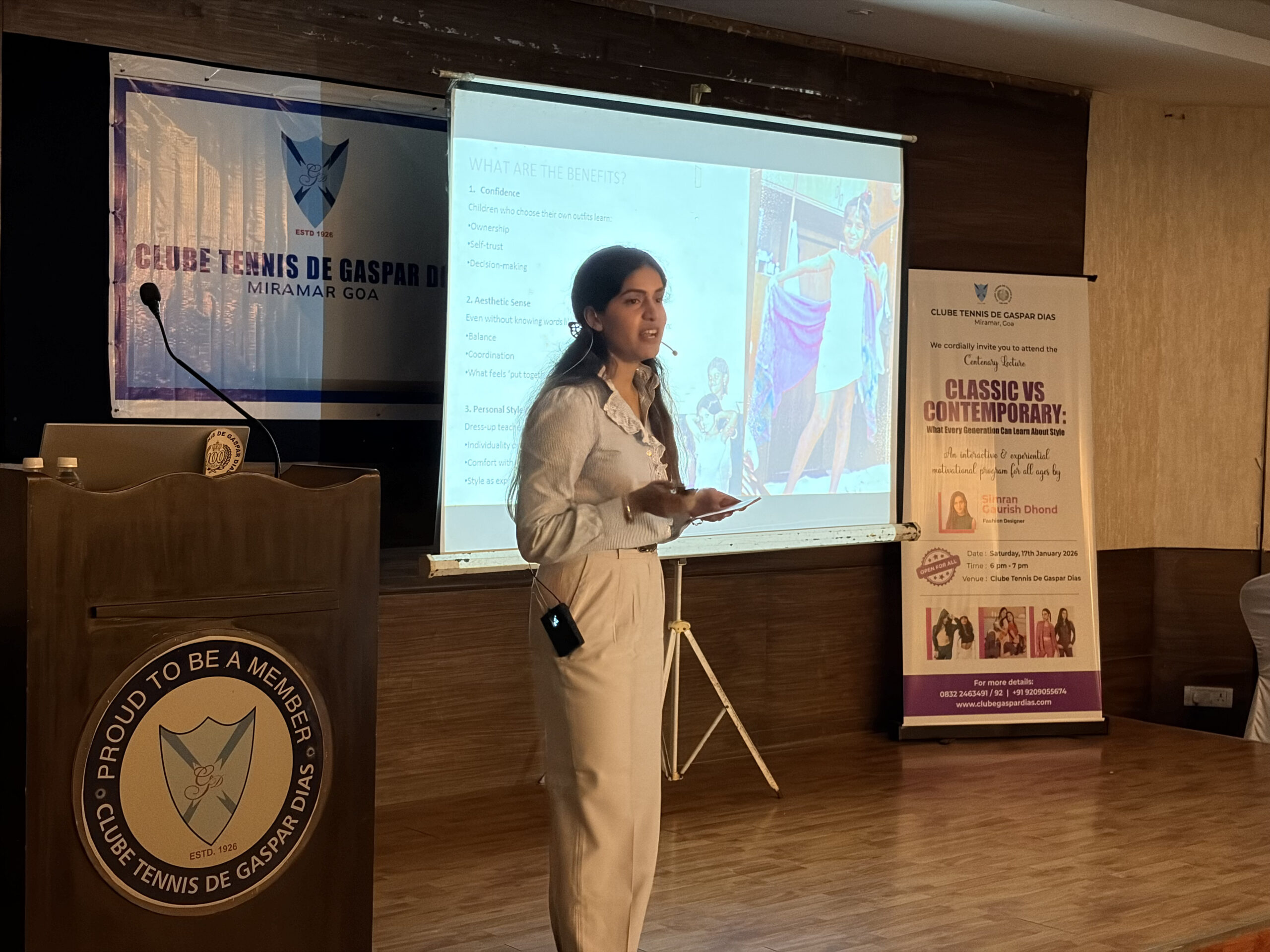
Wars have certainly had an impact on the silhouettes and style of women’s clothing, according to multidisciplinary Goan fashion designer Simran Dhond. She was delivering a centenary lecture titled ‘Classic vs Contemporary – What Every Generation Can Learn About Style,’ as part of the ongoing centenary celebrations at Clube Tennis de Gaspar Dias.
When asked about her opinion on the economy influencing the length of a woman’s clothing, especially skirts, she said: “During World War I, the skirts did change silhouettes and style; they started becoming more functional, when earlier women wore really long skirts. Later, they realised the need to bring it (the hemline) up to their knees to enable them to move quicker and get a lot more things done.”
She also pointed out that variations in fashion differ from culture to culture, and in India, where women wearing short skirts are a comparable minority, the impact may have led to a smarter drape of a saree.
While speaking at the lecture, Dhond, who earned a master’s in fashion and textiles from De Montfort University, England and a gold medal-winner in knitwear design from the National Institute of Fashion Technology, Bengaluru, focused on the evolution of contemporary fashion, stressing the fact that personal style should encompass comfort and longevity vis-à-vis following trends blindly.
“Even in contemporary styling, you need to make it more about personality. While classic is more structured, contemporary is more fluid and it sort of embodies you,” said Dhond, who currently leads Design & Brand Development at Carbon Tree, a conscious activewear label.
During a subsequent interaction with the audience, Dhond shared insights into how fashion embeds itself into every aspect of life. When asked about the colonial hangover, especially with regard to the uniforms of the armed forces, Dhond shared that it’s more about functionality rather than aping the West.
“The uniforms, like most outfits, are about functionality. Because it’s easier for movement when you dress a certain way, with shirts tucked in or out. If you look at Indian wear, kurtas for instance, they normally dangle and move around; they’re not very functional when you’re in combat. You would want something that sits to your body, and is structured and gives you a chance to camouflage in,” she said.
To another question about local textiles, Dhond highlighted the fact that Indian crafts and textiles are finally getting their due on the global stage, citing that brands like Dior have lately acknowledged that they have been getting their work done from the Chanakya School of Craft in Mumbai.
“This was all hush-hush for so many years and no one spoke about India, no one wanted to say our beautiful Chanel gowns come from India. But then Dior had an entire fashion show in Mumbai and they showed the artisans, they showed the behind the scenes,” Dhond said, adding that the exposition catapulted India’s role in elite fashion to a global platform.