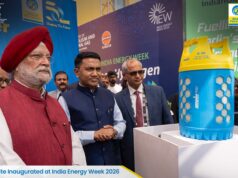

The third day of India Energy Week 2026 concluded with a clear emphasis on aligning policy, data, technology and investment to meet India’s rapidly expanding energy needs, as leaders from government, industry and global institutions outlined pathways for a secure, resilient and inclusive energy future.
At the Global Energy Conclave, during the session marking the release of the IEA India Bioenergy Market Report: Outlook for Liquid and Gaseous Biofuels to 2030 and the 5th edition of the PPAC Journal Ensuring Energy Security: Role of State Energy Policies, Neeraj Mittal, Secretary, Ministry of Petroleum and Natural Gas, said India’s bioenergy sector has the potential to grow significantly faster than overall energy demand and emerge as a key pillar of energy security, emissions reduction and rural development.
“India’s energy consumption is in the lower half globally on a per capita basis, but its growth rate is almost twice the world average. In the next decade, India’s energy growth could outstrip global growth by a factor of two or more,” he said. Highlighting policy-led outcomes, he cited the ethanol blending programme, noting that blending has risen from 1.4 percent in 2014 to nearly 20 percent today, with similar targets set for biodiesel, compressed biogas and sustainable aviation fuel.
Dr. Paolo Frankl, Head, Renewable Energy Division, International Energy Agency, presented key findings from the IEA report, stating that India has tripled its consumption of modern bioenergy since 2020 and could double deployment again by 2030 under enhanced policy implementation.
In another Leadership Spotlight Session titled Empowering economic policy with energy data: steering India’s growth towards Viksit Bharat 2047, Pankaj Jain, Former Secretary, Ministry of Petroleum and Natural Gas and Member Secretary, Eighth Central Pay Commission, cautioned against reactive planning.
“Energy cannot play catch-up. Energy has to anticipate,” he said, calling for integration of data across petroleum, power, coal and gas to support macroeconomic forecasting and infrastructure prioritisation.
At the Leadership Spotlight Session on leveraging artificial intelligence in the upstream sector, Rajarshi Gupta, Managing Director and CEO, ONGC Videsh Limited, said India is undergoing a fundamental shift in how exploration data is created, shared and used, emphasising collaboration and the need to break silos to unlock value from AI-driven decision-making.
In another Leadership Spotlight Session on The Solar and Wind Opportunity: Realising the Dual Potential of Scaling India’s Renewables, Santosh Kumar Sarangi, Secretary, Ministry of New and Renewable Energy, said India must move beyond capacity expansion to focus on grid integration and domestic manufacturing, noting that non-fossil fuel capacity has reached around 267 GW.
At the leadership panel Coal’s evolving role in a secure energy mix: charting a balanced and pragmatic approach, Vikram Dev Dutt, Secretary, Ministry of Coal, said affordable and dependable baseload power remains imperative as India works towards tripling per capita energy consumption, even as renewables scale up.
In the Leadership Spotlight Session on Scaling Green Ammonia: Value Chain Synergies and the Hydrogen Ecosystem, Abhay Bakre, Mission Director, National Green Hydrogen Mission, said India’s green hydrogen ecosystem is moving decisively from ambition to execution, supported by competitive renewable energy costs, policy certainty and global partnerships.
As the third day concluded, India Energy Week 2026 reaffirmed that India’s energy transition will be defined not by a single pathway, but by a coordinated approach that balances growth with sustainability, innovation with reliability, and ambition with realism. With policy certainty, data-driven decision-making and collaboration across stakeholders, India continues to strengthen its position as a central force shaping the future of global energy systems.