
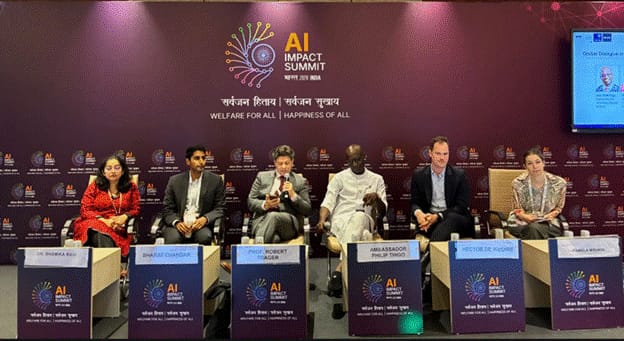
The session on “Global Dialogue on AI Usage – Data for Labour Market Resilience” on the second day of India AI Impact Summit 2026 focused on the changing nature of work and job scenarios in the context of accelerating artificial intelligence adoption and the policy choices required to manage this transition. Drawing on emerging international evidence, the discussion noted differentiated impacts across age groups, sectors, and geographies, with early trends indicating employment pressures for younger workers in roles with higher AI exposure.
The panelists emphasised that the lack of comprehensive and comparable data across countries continues to constrain the ability of governments to design timely and targeted interventions. The conversation underlined the importance of moving ahead with adaptive policy frameworks even in the absence of perfect information, strengthening social protection systems, and expanding re-skilling pathways. The need for context-specific strategies for sectors such as services, agriculture, and public delivery, supported by international cooperation and shared learning, was highlighted as central to ensuring that AI adoption leads to inclusive growth.
Shamika Ravi, Member, Economic Advisory Council to the Prime Minister, said, “India shows one of the highest levels of AI adoption at the firm level, marked by both openness and optimism. While the productivity effects are still being measured, AI in India is likely to be applied to long-standing challenges—particularly in health, education and services—where last-mile connectivity constraints have traditionally limited outcomes.”
Ambassador Philip Thigo, Special Envoy for Technology, Republic of Kenya, said, “Preparing for AI-driven transitions requires more than reskilling and upskilling; it also demands strong social protection systems. In countries like Kenya, with a very young population alongside ageing workers in key sectors such as agriculture, policy must support innovation while ensuring that people across generations are protected throughout this transition.”
Hector de Revoire, Director, Responsible AI Public Policy, Microsoft, said, “Most of the evidence we currently have on AI’s employment impact comes from a few countries, particularly the United States. In many other regions, including emerging economies, the data simply does not yet exist, making it difficult to draw firm conclusions and underlining the need for the systematic collection of adoption and employment data globally.”
Yoshua Bengio, professor at the Université de Montréal and a leading global AI expert, started the session and said that the trends we see in AI impact on jobs in the last five years, will continue to have a significant impact on the job market. Access to AI will become an advantage, while countries with no access to AI will be at a competitive disadvantage. Hence, we need international coordination to ward off its ill effects, and help AI in steering in a direction which is good for everyone. Alliances need to be formed and dialogues need to take place.
Pamela Mishkin, Research at OpenAI, said, “Resilience is not about predicting a single future, but about planning for multiple possible scenarios. Waiting for perfect usage data before acting risks being too late, especially when it comes to supporting workers through difficult transitions. Policy should focus on understanding what the transition should look like, rather than just the long-term outcome.”
Bharat Chandar, Stanford Digital Economy Lab, said, “Research shows a clear distinction between AI exposure and AI adoption. Jobs that are more exposed to AI have seen a significant decline in employment for young workers, while firm-level adoption shows mixed effects. This gap highlights the need for better data on executive expectations, firm-level AI usage, and productivity to understand how AI is shaping hiring decisions.”
The session highlighted that strengthening labour market resilience in the AI era will require better measurement of technology adoption, anticipatory governance, and coordinated investments in skills, social protection, and institutional capacity so that productivity gains translate into broad-based economic and social benefits.