
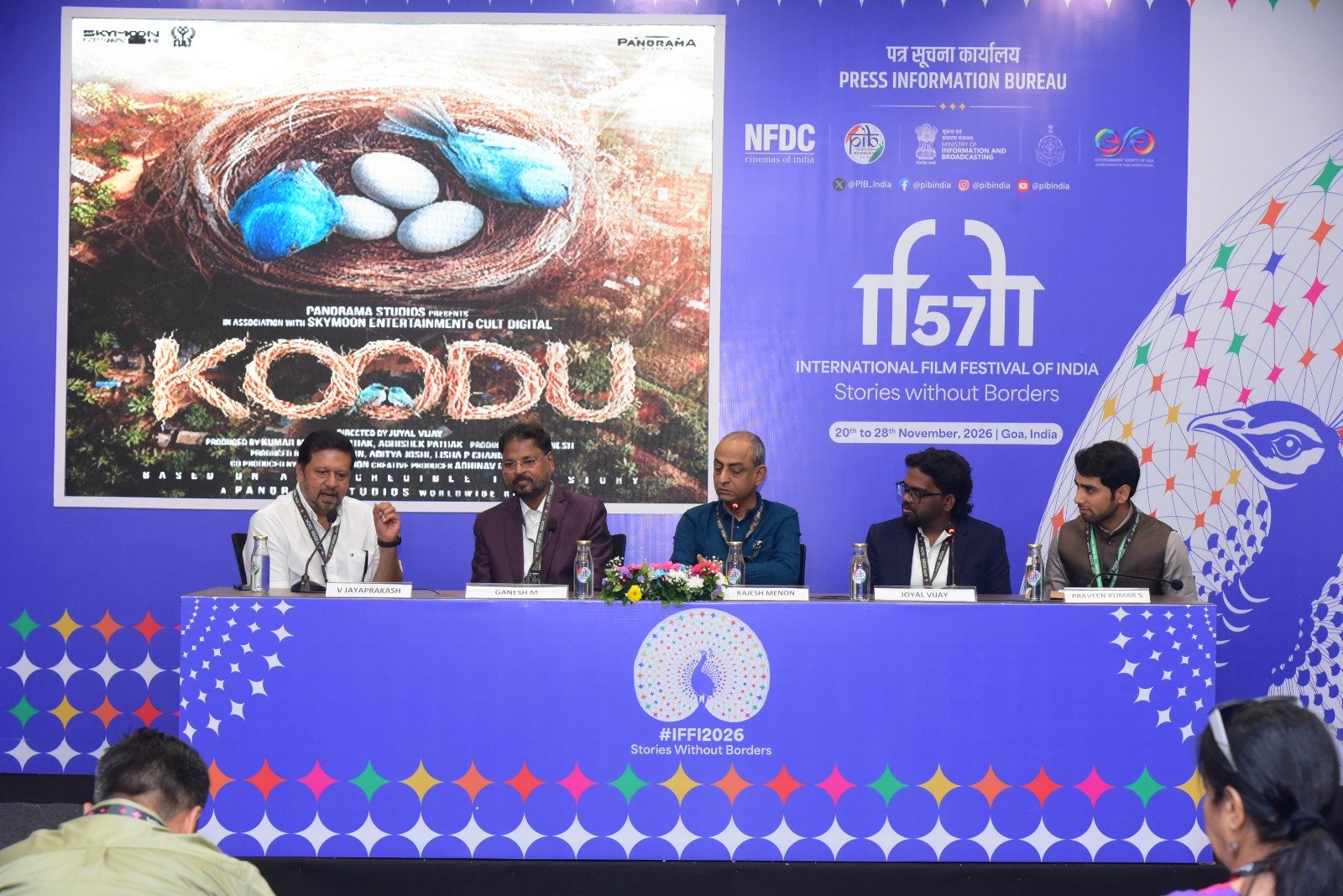
Director Joyal Vijay, along with producers Rajesh Menon and Ganesh M, and actor V. Jayaprakash, interacted with the media at a press conference organised by the Press Information Bureau (PIB) on the sidelines of the 57th International Film Festival of India (IFFI) in Goa today. The team shared insights into their film Koodu (Nest), its inspiration and its underlying environmental message.
Set in Vachathi, Tamil Nadu, the film unfolds when a power outage leads to the discovery of a sparrow’s nest containing eggs inside a village transformer. Guided by village head Agathiyan, agriculture graduate Kathir and the villagers decide to go without electricity for 35 days to protect the birds. However, their decision faces strong opposition. Despite these challenges, Kathir and the villagers make considerable sacrifices to ensure the nest remains safe.
Through the film, director Joyal Vijay sought to convey that the earth does not belong to human beings alone but is also home to countless other living creatures. Emphasising the importance of coexistence, he said that humans must recognise their responsibility to respect, protect and live in harmony with other forms of life.
Actor V. Jayaprakash shared how being part of the film influenced his personal habits. He said he agreed to the project within minutes of hearing its synopsis, particularly drawn by the fact that it was based on a real-life incident.
Reflecting on the film’s environmental message, he said his biggest personal takeaway was becoming more conscious of his use of tissue paper, recognising the connection between everyday consumption and the cutting down of trees. He added that the film had encouraged him to minimise its use in his daily life, highlighting how its message had influenced his personal habits.
Producer Rajesh Menon highlighted the emotional appeal of the story and the screenplay’s engaging approach to communicating its environmental message. He noted that the film addresses the practical questions and challenges that arise from the villagers’ decision to remain without electricity for 35 days, using meaningful dialogues and relatable situations rather than presenting the subject in an overly serious manner. He also said that the film’s underlying message and relevance to audiences motivated them to support the project.