

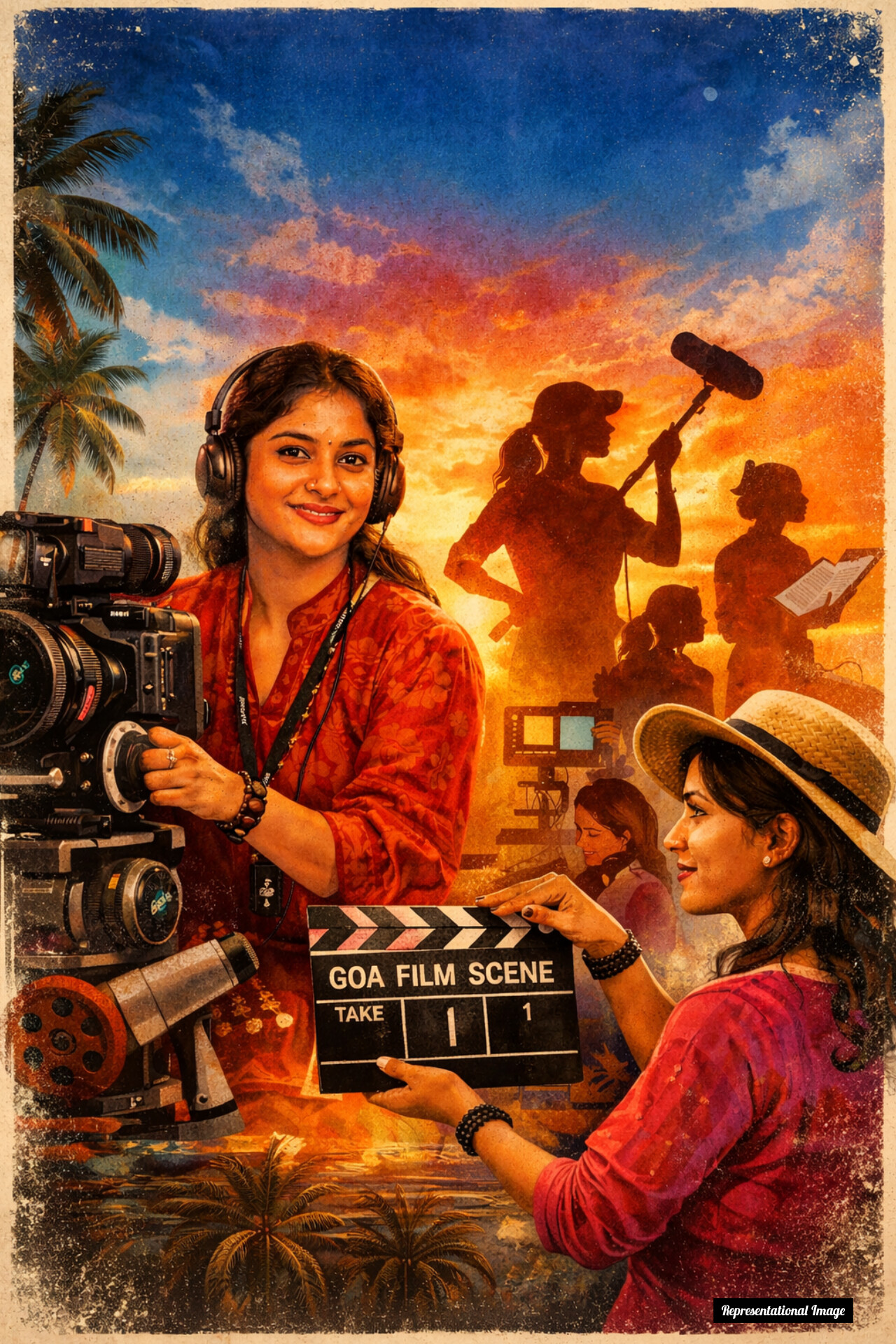
As International Women’s Day on March 8 approaches, conversations about representation in Goa’s creative industries are gaining momentum. While Goan cinema continues to produce films rooted in culture, identity, and social realities, women remain underrepresented behind the camera. This raises an important question within the industry: does Goan cinema need more women filmmakers?
Valanka Fernandes, co-director with Shaurya Neer of Naturally Educated, addressed the issue of representation through her work. Developed during a workshop conducted by Fundacao Oriente, the documentary was later screened at the Footprint International Film Festival. The film follows educator Vishal Rawlley as he explores alternatives to traditional classroom systems through a nature-based micro-school model.
Fernandes stated that Goa needs more women in filmmaking because women bring emotional intelligence, sensitivity, and lived perspectives that cinema genuinely requires. She added that although the number of women filmmakers in Goa is gradually increasing, stronger community encouragement and institutional support remain essential.
Representing the growing intersection of cinema and technology is Saisma Naik, director of Toto, an AI-driven film centred on a dog. The project is set to become the first AI-generated film directed by a Goan woman and has been selected for the AI Impact Summit at Bharat Mandapam from March 16–20, 2026.
Naik has observed that women filmmakers in Goa often face limited opportunities, funding challenges, and are not always taken as seriously as their male counterparts. However, she emphasised that women bring authentic and powerful perspectives to storytelling. According to her, equal space and sustained support for women behind the camera will contribute to a richer and more inclusive cinematic culture.
Among the most recognised women filmmakers in Goa is Prachi Shirodkar, a documentary filmmaker and actress whose work has earned national and international acclaim. She has received the Best Documentary Award at the Miseentage Indian Film Awards, Best Documentary at the Amader International Short Film Festival, and the Best Student Documentary Award at the Goa International Film Competition, along with a Best Director Festival Mention at Amader and several other international selections. As an actress, she has appeared in Smoke and Mirrors and Imagine If It Was You, demonstrating versatility across genres. Currently working as an art director and assistant director on films and commercials, she continues to deepen her practical understanding of the craft.
Director Prachi Shirodkar believes that Goa urgently needs more women filmmakers and stronger practical training platforms. “We need more female filmmakers,” she says. “There should be a dedicated platform in Goa where aspiring filmmakers can learn the practical process of filmmaking. Working on a set is very different from studying theory. Without hands-on experience, it can be extremely challenging. A structured course that teaches how things truly function on set would make a huge difference. Theory introduces you to the basics, but there is so much more to learn beyond that.”She also highlights the unique strengths women bring to storytelling.
According to her, women often think deeply and bring strong emotional awareness to their work. “Many women are intuitive, sensitive, and capable of offering unique perspectives. They approach stories with maturity and depth, noticing subtle details through observation and instinct.”
Shirodkar shares that she is personally drawn to emotionally driven, real-life narratives. She believes women have a powerful ability to express such stories with authenticity and insight. “Women often have a natural ability to analyze deeply. When that insight is translated onto paper, the result can be powerful.”She further adds that filmmaking is vast and filled with countless stories waiting to be told.
“If more women choose filmmaking as a career — leading, writing, and directing — the impact would be significant. Seeing women in positions of authority is inspiring, especially in an industry where men have traditionally held more power. A woman director or producer manages many responsibilities, and from that leadership, remarkable films and documentaries can emerge.”Emphasizing the importance of emotional connection in cinema, she notes, “Women often communicate with clarity and emotional intelligence. Since filmmaking is about connecting with audiences, this strength can make storytelling even more meaningful. With more female filmmakers, the filmmaking landscape in Goa could truly transform.”
Emerging director Sharvi Dhond, who has worked on films such as The Awakening, Illuminate, and Smoke and Mirrors, is set to make her directorial debut in 2026. Her upcoming projects include From Goalpost to Glory, a documentary on Goan football legend Brahmanand Shankwalkar; Her Unfinished Chapters; Sherine’s Intermission, starring Falak Fatima Siddiqui and exploring the psychological impact of immersive acting; and A Wounded Past, featuring Varun Thanki alongside debutant Aakanksha Bakhale, which addresses the issue of drug abuse.
Describing herself as a feminist filmmaker, Dhond argues that the need for more women in cinema extends beyond representation—it is about perspective. She believes women bring lived experiences and nuanced storytelling that can challenge conventional narratives and expand creative possibilities.
Industry observers suggest that strengthening representation will require inclusive funding policies, mentorship programmes, structured skill-based training initiatives, and safe working environments. Dedicated platforms highlighting women-led projects could further enhance visibility and participation.
As Goa’s film industry continues to evolve, the conversation around gender representation remains central to its growth. With women contributing across documentary, fiction, and experimental formats, sustained support and equal opportunity could help shape a more diverse, balanced, and forward-looking cinematic future for the state.
