

Shekhar Kuttikar from Taleigao, a lifelong fisherman, doesn’t see turtles as just marine animals. “As fishermen, we consider turtles sacred, like God,” he says. Over the years, he has rescued and released more than 100 of them, sometimes cutting through his own nets to set one free. To him, it’s simply the right thing to do.
Beaches like Morjim, Agonda and Galgibag have long been nesting grounds for the endangered Olive Ridley sea turtles. Earlier, their arrival each summer felt routine. Under moonlight, they would quietly come ashore to lay eggs. Now, things have changed. Hotels and shacks flood the coastline with artificial light. “They cannot tell whether it is the moon or just bright lights,” Kuttikar explains. “Because of this, they get confused and don’t reach the right place to lay eggs.”
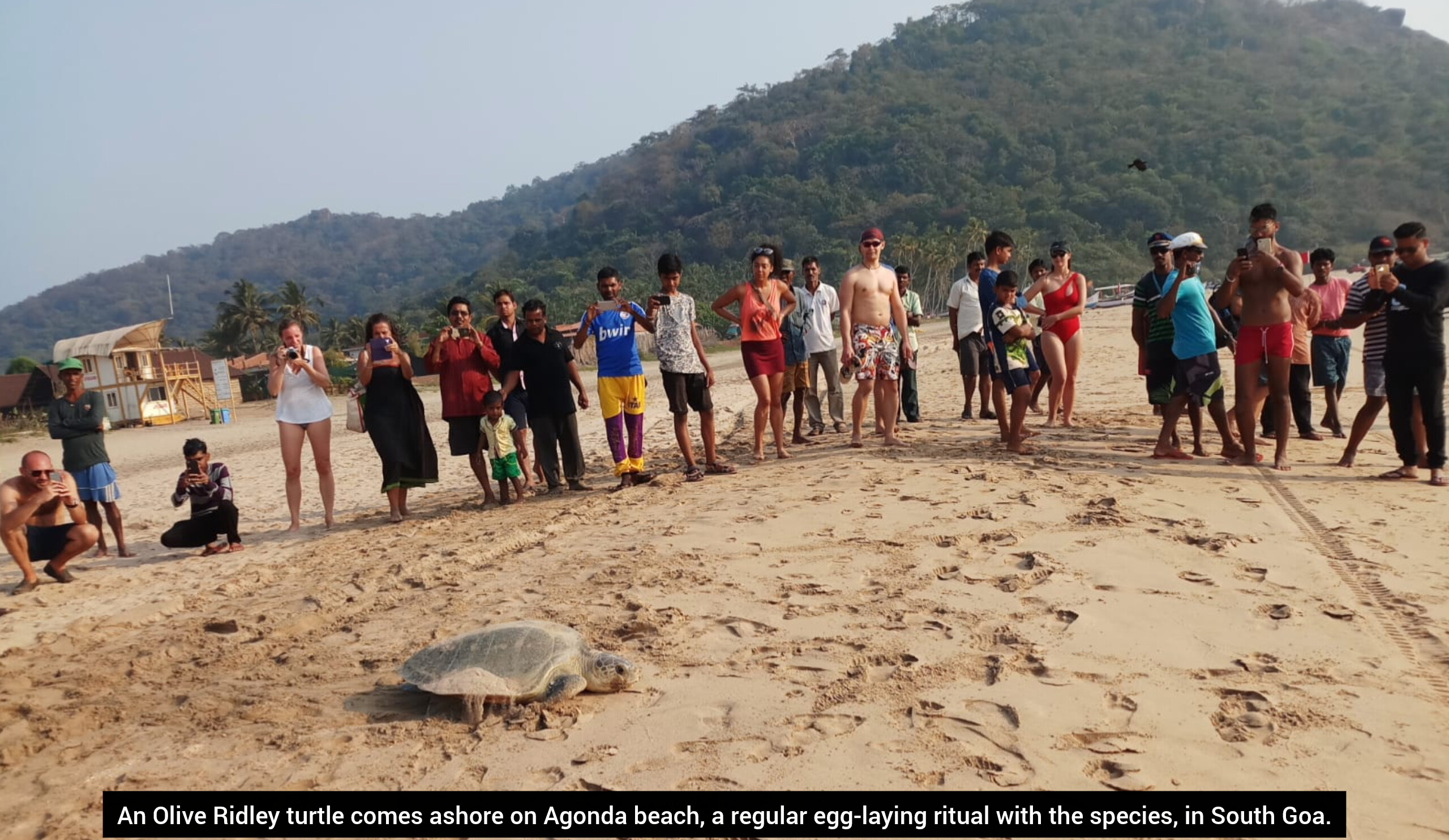
Crowds add to the disturbance. People moving around, taking photos and making noise often cause turtles to turn back without nesting. Beneath the surface, trawling, overfishing and engine oil from boats have slowly degraded the marine ecosystem turtles depend on. When the sea suffers, everything in it suffers alongside.
When a turtle washes ashore, lifeguards from Drishti Marine are usually the first responders. Shashikant Jadhav, operations manager at the lifesaving agency, describes their process: “We go with gloves and scissors, cut the nets and free them. If the turtle is injured, we hand it over to a vet; if it’s fine, we release it back into the sea.”
The lifesaving agency, which has a manpower of around 450 lifesavers – most of whom are posted along the coastline – perform the role of first responder in case of any marine emergencies. Jadhav urges fishermen not to leave nets behind, as they drift ashore and pose serious risks.
Lifesaver Amit Mahale, stationed in North Goa, explains Drishti Marine’s alert system: a live turtle is classified as Code 1, a freshly dead turtle is Code 2 and a decomposing corpse is Code 3. Photos are shared with the Forest Department and a lifesaver remains on site until officials arrive. Often, the bigger challenge isn’t the rescue. It is the crowd.
“People gather quickly and try to take photos. Some even argue when we ask them to move back,” says Mahale. During nesting, even small disturbances can make turtles retreat. “If people go too close, the turtle may return to the sea without laying any eggs,” he adds.
Ghost nets, abandoned fishing gear drifting at sea, are among the quietest killers. “Sometimes the net gets tangled around their neck, which can even lead to death,” says Kuttikar. Kuttikar also worries about turtles found dead on the shore. His appeal is simple: “Please do not harm the turtles. If you find one alive, let it go. If it’s dead, bury it.”
In India, sea turtles are protected under Schedule I of the Wildlife Protection Act, 1972, the highest level of legal protection given to any animal. World Turtle Day is a reminder that survival doesn’t always require grand gestures. Sometimes it is a fisherman cutting his net, a lifesaver holding back a crowd, or a tourist choosing to step away. For a creature that has outlived almost everything on this planet, the least we can do is give it space.
