
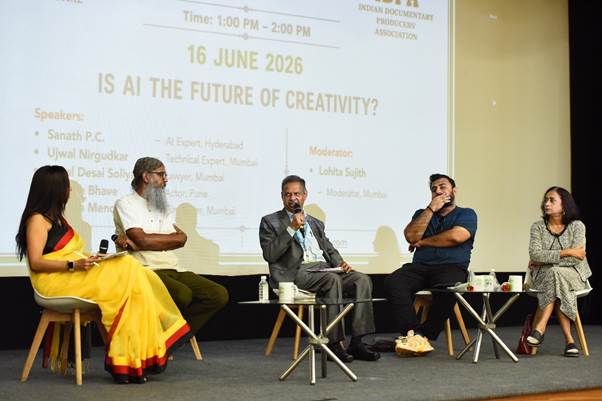
The Indian Documentary Producers Association (IDPA) organised an Open Forum on the theme, “Is AI the Future of Creativity?” during the 19th Mumbai International Film Festival (MIFF). The session brought together Sanath P.C., Co-founder, Firefly Creative Studio Pvt. Ltd., Ujwal Nirgudkar, Chairman, SMPTE, lawyer Hetal Desai Soliya and filmmaker Subodh Menon, Director – Fanboy Pictures, to discuss the opportunities, challenges and implications of AI in filmmaking and content creation.
The discussion explored the growing role of artificial intelligence in the creative ecosystem, with panelists examining its impact on storytelling, production processes and the future of the film industry. While acknowledging the transformative potential of AI, the panelists emphasised that human creativity and emotional intelligence remain central to the art of storytelling.
Speaking on the technological evolution of cinema, Ujwal Nirgudkar, Chairman, SMPTE, described AI as the next natural stage in filmmaking. He highlighted its growing role in post-production, including sound enhancement, colour correction, visual improvements and film restoration. He also noted that while AI tools are evolving rapidly, the industry will need time to standardise and fully adopt them.
Filmmaker Subodh Menon, Director – Fanboy Pictures., emphasised that while AI can generate content and assist in brainstorming, storytelling remains fundamentally human. He described AI as a valuable tool for idea generation and validation and said that understanding AI will be increasingly important for filmmakers as the technology becomes more widely adopted.
Sanath P.C, Co-founder, Firefly Creative Studio Pvt. Ltd, observed that AI can enhance storytelling by improving image quality, sound and audience experience. Describing the current period as experimental, he said creators should explore AI’s possibilities while using it as a support tool rather than relying on it completely.
Addressing the legal aspects of AI-generated content, Hetal Desai Soliya stressed the importance of using licensed data and ensuring sufficient human involvement in creative works. She noted that copyright ownership rests with human creators and advised filmmakers to use AI to enhance, rather than replace, original content.
The panelists agreed that AI should be viewed as a powerful enabler that complements rather than replaces human creativity. They emphasised that while AI can streamline production processes, enhance efficiency and expand creative possibilities, the essence of storytelling continues to lie in human imagination, emotion and artistic vision.
The discussion was followed by an engaging interaction with the audience, during which participants explored questions relating to AI adoption, ethical concerns, copyright protection and the future of creative professions. The session concluded with a consensus that filmmakers must embrace technological change while ensuring that human creativity remains at the centre of the storytelling process.