
by Manali Acharya
We live in a world where information is available at our fingertips. With a smartphone, we can access thousands of books, newspapers, articles and stories within seconds. Yet, how many of us actually make time to read something meaningful every day? We spend hours scrolling through social media, watching short videos and browsing the internet, but often struggle to devote even fifteen minutes to reading a book. Perhaps this National Book Week is the right time to rediscover a simple pleasure that can make a remarkable difference in our lives.
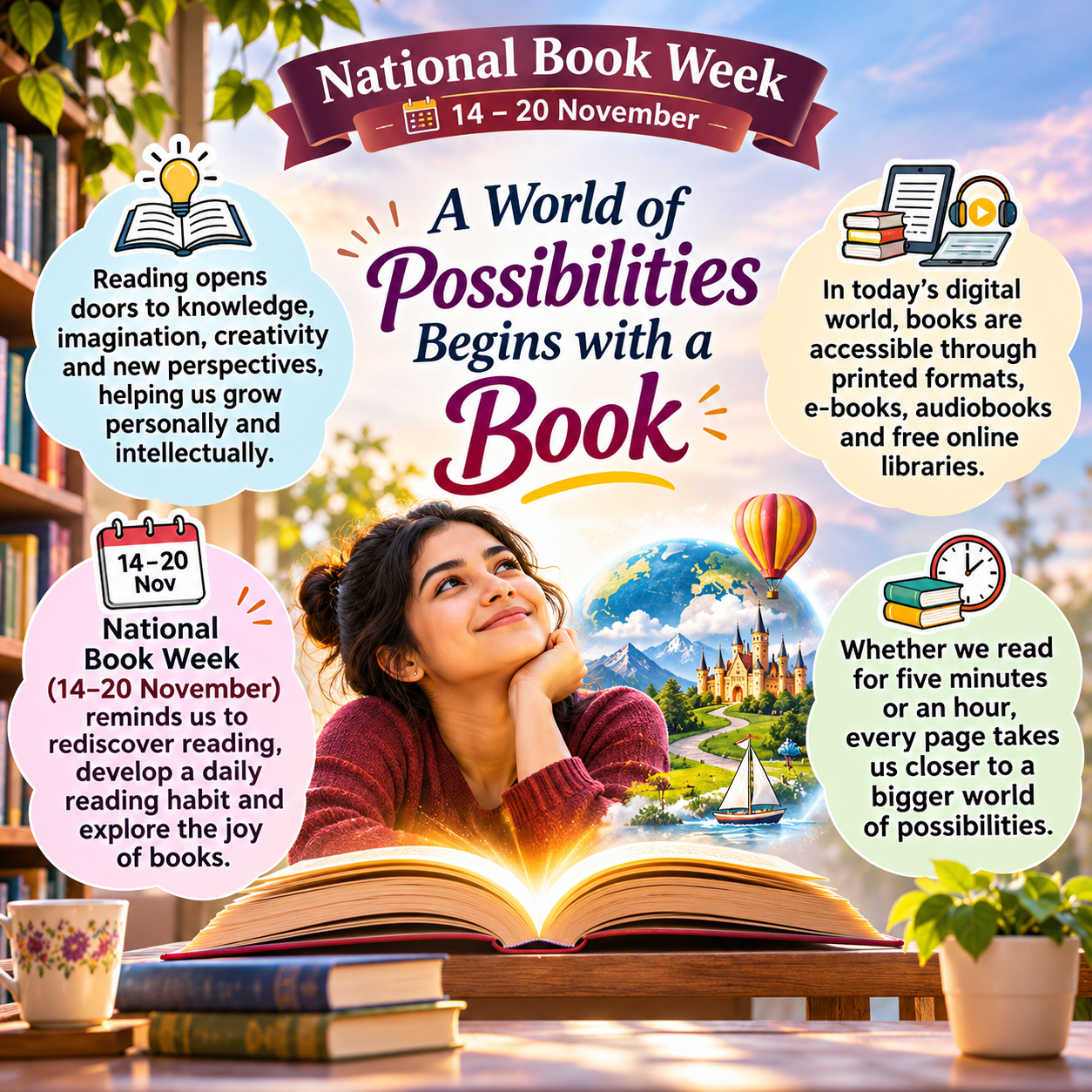
Celebrated from 14th to 20th November every year, National Book Week is an initiative of the National Book Trust, India, launched in 1982 to promote books and cultivate reading habits across the country. The occasion reminds us that reading is not merely an academic activity or a requirement for examinations. It is a lifelong habit that broadens our understanding, stimulates our imagination and helps us become more informed individuals.
Reading is more than collecting information
A good book can take us to places we have never visited, introduce us to people we have never met and expose us to ideas we may never have considered. Reading develops vocabulary, improves language and communication skills, encourages critical thinking and strengthens our ability to understand different perspectives. Fiction can nurture imagination and empathy, while biographies, history, science and non-fiction books can introduce us to new discoveries, experiences and ways of thinking.
Reading can also offer a welcome pause from our busy routines. Sitting with a book, even for a few minutes, gives us an opportunity to slow down, reflect and focus on something beyond our everyday responsibilities. It need not always be serious or educational. A humorous story, a mystery novel or a collection of poems can be equally rewarding.
The way we read is changing
For generations, the printed book has remained a trusted companion. However, reading today is no longer restricted to the pages of a physical book. E-books, audiobooks, digital magazines, online newspapers and digital libraries have created new opportunities for readers.
A student can read an e-book on a smartphone while travelling. A homemaker can listen to an audiobook while completing household activities. A working professional can explore an informative article during a lunch break, while a senior citizen can enjoy digital books in a comfortable font size.
Technology, therefore, need not be viewed as an enemy of reading. If used thoughtfully, the same smartphone that keeps us occupied with endless scrolling can become a personal reading companion.
Your next book could be just a click away
One common reason people give for not reading is that books are expensive or difficult to access. Fortunately, several digital platforms provide opportunities to explore books and educational resources, many of them free of charge.
Here are a few worth discovering:
- Rashtriya e-Pustakalaya (https://ndl.education.gov.in/): An initiative of the Ministry of Education, Government of India, implemented by the National Book Trust. It offers a growing collection of children’s and young adults’ books in English and several Indian languages, across genres such as fiction, biographies, comics, poetry and science.
- National Digital Library of India (https://ndl.iitkgp.ac.in/): A valuable resource for students, teachers and research scholars, offering access to a wide range of learning materials, including books, articles, theses and educational resources.
- ePathshala (https://epathshala.ncert.gov.in/): Developed by NCERT, this platform provides digital textbooks, audio, video, e-books and other educational resources that can be accessed through computers and mobile devices.
- Project Gutenberg (https://www.gutenberg.org/): A wonderful destination for lovers of classic literature, offering thousands of free e-books that are in the public domain.
- Sugamya Pustakalaya (https://www.sugamyapustakalaya.org.in/): Accessible books in multiple Indian languages and formats for persons with print disabilities.
- StoryWeaver (https://storyweaver.org.in/): An initiative by Pratham Books that offers illustrated children’s stories in multiple languages, making reading enjoyable and accessible to young readers.
Apart from these, readers can explore audiobooks, educational podcasts, online newspapers, literary blogs and digital magazines. The important thing is to find a format and subject that makes reading enjoyable.
Seven simple ways to bring reading into everyday life
Developing a reading habit does not require a major lifestyle change. A few small steps can make a difference.
- Begin with 15 minutes a day: Set aside a fixed time, perhaps before going to bed or early in the morning. Start with five pages if fifteen minutes seems difficult.
- Replace scrolling with reading: Instead of spending every free moment on social media, use ten minutes to read an article, story or book chapter.
- Carry a book with you: A small paperback or an e-book on your phone can turn waiting time into reading time.
- Explore different genres: Do not restrict yourself to textbooks or subjects related to your profession. Try fiction, travel, biographies, history, science, humour or poetry.
- Maintain a reading journal: Write down an interesting idea, a new word or a favourite quotation from what you read.
- Read together: Encourage children, parents, friends and colleagues to share stories and discuss books. Reading can become a wonderful family activity.
- Recommend a book: When you discover a good book, share it with someone. A simple recommendation can introduce another person to the joy of reading.
A seven-day challenge to rediscover reading
This National Book Week, why not take up a small personal challenge? Read a short story on the first day, explore a digital library on the second, try an unfamiliar subject on the third, listen to an audiobook on the fourth, read with a family member on the fifth, write down an interesting takeaway on the sixth and recommend a book to a friend on the seventh.
By the end of the week, you may discover that reading is not as difficult to accommodate in your daily routine as you once thought.
Let us make reading a way of life
Libraries have an important role to play in building a reading culture. They are not merely places where books are stored infact they are spaces where curiosity is encouraged, knowledge is shared and minds are enriched. Modern libraries are also evolving into digital learning centres, connecting readers with information and resources beyond the physical shelves.
As we observe National Book Week, let us remember that there is no single age to begin reading and no particular genre that everyone must follow. A child may begin with picture books, a student with an inspiring biography, a professional with a book on personal development and an older reader with a favourite novel.
We do not have to finish a book every week or read hundreds of pages every day. We simply have to begin. Pick up a book, open an e-book, listen to a story or visit your nearest library. Give reading a little space in your everyday life.
After all, a little reading each day can open up a much bigger world.
(The writer is the Librarian at St.Joseph Vaz College, Cortalim-Goa)