
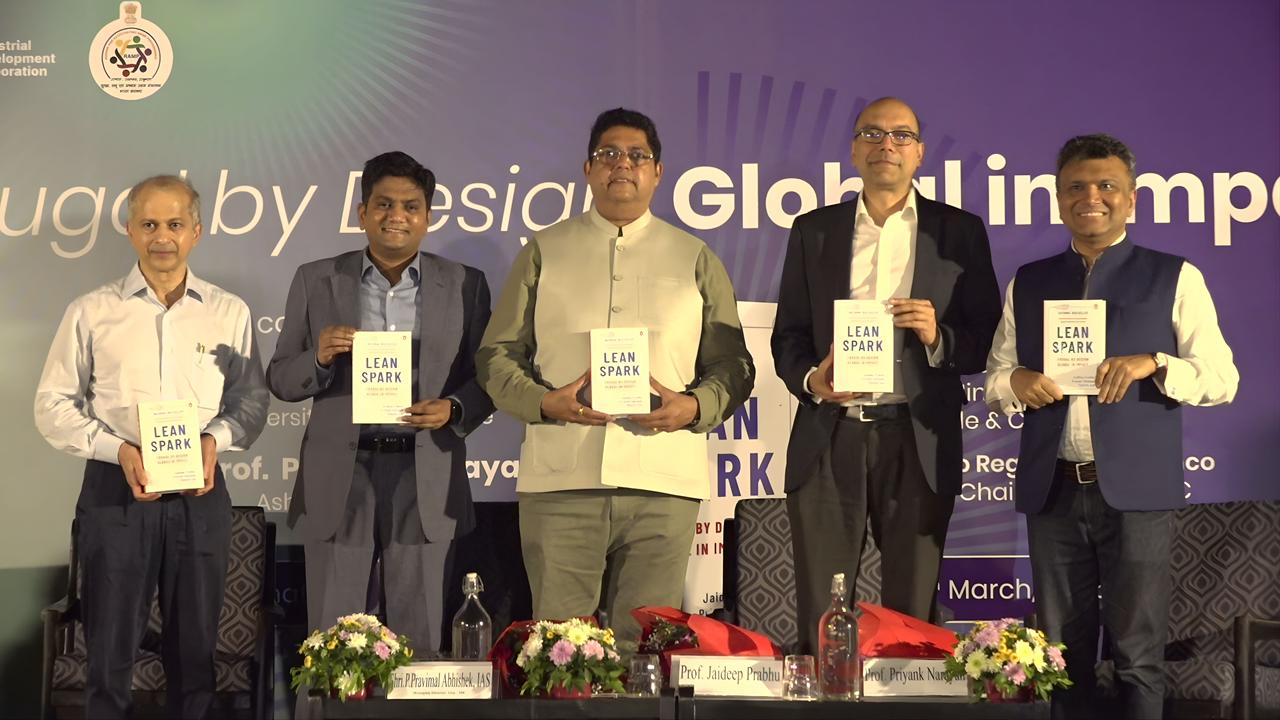
An engaging and insightful edition of the ICG Public Lecture Series titled “Frugal by Design, Global by Impact” was successfully hosted at the International Centre Goa, Dona Paula, on Friday evening. The event, jointly organised by Goa-IDC, the Directorate of Industries, Trade and Commerce (DITC) and International Centre Goa (ICG), brought together global thought leaders, industry stakeholders, entrepreneurs and members of the MSME ecosystem from across Goa.
The session featured an enriching and thought-provoking conversation with globally acclaimed experts and co-authors of Lean Spark-Frugal by Design Global in Impact, Professor Jaideep Prabhu of the University of Cambridge and Professor Priyank Narayan of Ashoka University, who shared deep insights into the evolving landscape of Frugal Innovation and its growing relevance in today’s dynamic Global Economy in the presence of Aleixo Reginaldo Lourenco, Chairman, Goa-IDC and Pravimal Abhishek, IAS, Managing Director, Goa-IDC.
Addressing the gathering, Pravimal Abhishek, IAS, Managing Director, Goa-IDC, highlighted how “Frugal innovation has the potential to significantly propel economy like India by enabling scalable, cost-effective and high-impact solutions. Platforms like this create a valuable opportunity for academia and industry to come together, exchange ideas and co-create solutions for the future. Goa is steadily setting a benchmark in this space by fostering an ecosystem that encourages innovation, collaboration and global thinking among its MSMEs.”
Professor Jaideep Prabhu, a globally recognised authority on innovation and co-author of the international bestseller Frugal Innovation, shared valuable perspectives stated “Very few parts of the world have been able to deliver solutions at the price points that India has achieved, without compromising on effectiveness. This is what makes Indian frugal innovation truly distinctive—it is not about being low-cost, but about creating high-value solutions that are accessible, scalable and globally relevant. The challenge now is to make such innovation aspirational, so that consumers recognise value beyond just price.”
Elaborating further he mentioned how “Frugal innovation is often misunderstood as being synonymous with cheapness, when in reality it is about intelligent design, efficiency and long-term value. As seen in the evolution of ventures like REVA, design, perception and ecosystem support play a critical role in driving acceptance. If we are to truly unlock its potential, we must shift consumer mindsets—because frugal is value, not compromise and that is what will make it Aspirational.
Consumers with limited spending power don’t just seek affordability—they seek value with aspiration. The real essence of frugal innovation lies in creating solutions that are not only cost-effective but also desirable, combining smart design, strong brand appeal and innovative business models. From pricing breakthroughs like sachets to community-driven service delivery, true innovation happens when we rethink not just the product, but how it is designed, delivered, and experienced—making frugality a proactive strategy rather than a response to constraint.”
Professor Priyank Narayan, an accomplished academic and entrepreneur, complemented these insights by emphasising the importance of entrepreneurial thinking and agile business practices. He elaborated on how “Jugaad has evolved far beyond its perception as a makeshift, last-minute fix—it is now emerging as a deliberate philosophy of innovation. What we are witnessing today is a shift from reactive improvisation to intentional design, where solutions are built to be scalable, sustainable, and deeply inclusive from the outset.
Whether it is transforming school education through systemic interventions or expanding access to opportunities in sports and livelihoods, individuals and institutions are consciously applying frugal thinking to create meaningful impact at scale.”
Talking further he explained how “India’s journey with digital public infrastructure further reinforces this shift. Platforms like Aadhaar and Unified Payments Interface (UPI) exemplify how simplicity in design, when combined with affordability, can unlock unprecedented scale and accessibility. These are not accidental innovations—they are the result of carefully engineered, frugal systems designed to serve a billion people efficiently.
What defines this new era is the integration of product, service, and business model innovation. It is no longer just about creating something affordable, but about reimagining how it is delivered, who it reaches and how it sustains itself. In that sense, Jugaad is being redefined—not as a constraint-driven compromise, but as a powerful, strategic approach to innovation that balances cost, quality, and aspiration”.
The interactive session witnessed active participation from Industry leaders, entrepreneurs, students and policymakers, fostering a vibrant exchange of ideas and perspectives. The discussion reinforced the growing importance of collaboration between academia, industry and government in building a resilient and future-ready business ecosystem in Goa.
The event concluded on a high note, with participants gaining valuable insights into how innovation driven by affordability, adaptability and purpose can empower Goan MSMEs to enhance their competitiveness and expand their global footprint, further contributing to Goa’s economic growth story.