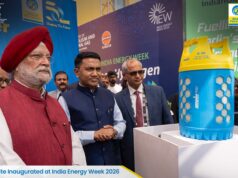

Solex Energy Limited, one of India’s leading solar module manufacturers and renewable energy innovators, listed on NSE: SOLEX, announced its participation at India Energy Week 2026 in Goa, marking a defining moment in our efforts to build India as a centre for advanced solar manufacturing and clean energy adoption. During the event, Solex introduced its TAPI Rear Contact (TRC) solar module, India’s first rear contact solar technology, now being showcased and prepared for deployment in Goa as part of the broader expansion into emerging clean energy markets.
India Energy Week remains the country’s foremost platform for global energy dialogue, policy coordination and technology exchange. Solex is honoured to represent India’s domestic manufacturing ecosystem at a time when the country is accelerating its clean energy ambitions and placing growing emphasis on high-efficiency, high-reliability renewable infrastructure.
Speaking at the event, Dr. Chetan Shah, Chairman & Managing Director of Solex Energy Limited, said: “Solex has always believed that India must not only consume solar power, but also lead in solar innovation. With the launch of our TAPI Rear Contact technology, we are bringing one of the most efficient and advanced cell architectures to India and now to Goa, a state that is rapidly emerging as a promising solar market. Goa’s solar industry is projected to grow from around ₹37 crore to nearly ₹325 crore by 2027, with the government setting out plans to equip almost half the state’s households with rooftop solar and developing model solar villages capable of running on round-the-clock solar power. These initiatives make Goa a natural fit for high-performance technology like TAPI, which offers higher yields, better temperature performance and long-term reliability in coastal environments. As Solex expands its presence in Goa, we are actively looking for EPC partners, channel partners and solution integrators who share our belief in making clean energy accessible, efficient and future-ready. Our vision remains clear: if India wants to lead the energy transition, Indian innovation must power Indian demand.”
The TAPI TRC module, powered by N-Type Rear Contact technology, delivers up to 24.60% efficiency and 665 W peak output with zero front shading and enhanced thermal behaviour, making it suitable for both rooftop and commercial-industrial applications where performance per square metre matters. Commercial production is expected to begin in FY27 as part of Solex’s Vision 2030 technology roadmap.
The introduction of TAPI TRC in Goa aligns with the state’s increasing shift towards decentralised energy models driven by rooftop solar, agriculture, hospitality and tourism, industrial consumers and community-based solar programmes. Solex is expanding its footprint in Goa and strengthening its base by actively inviting partnerships across EPC firms, channel distributors, installation companies, solution integrators and institutional customers as part of a long-term presence in the state.
Solex continues to enhance its research and manufacturing capabilities through its collaboration with ISC Konstanz in Germany, supporting the development of TOPCon, Rear Contact and tandem/perovskite cell technologies under India’s innovation and self-reliance ambitions. Under Vision 2030, Solex is progressing towards 10 GW of module and 10 GW of cell manufacturing capacity alongside a $1.5 billion investment plan and a skilled 25,000-member workforce.
With close to three decades of experience, a 4 GW automated PV module facility in Tadkeshwar, Gujarat, exports to international markets and OEM relationships with globally recognised brands, Solex has built a track record for high-efficiency products, consistency and long-term reliability, qualities we believe are essential for India’s clean energy transition.
Solex welcomes visitors, partners and stakeholders to India Energy Week 2026 at the ONGC Advanced Training Institute, Canacona, Goa, Booth No. 3G28 from January 27–30, 2026, and looks forward to building strong partnerships within the Goan ecosystem.