
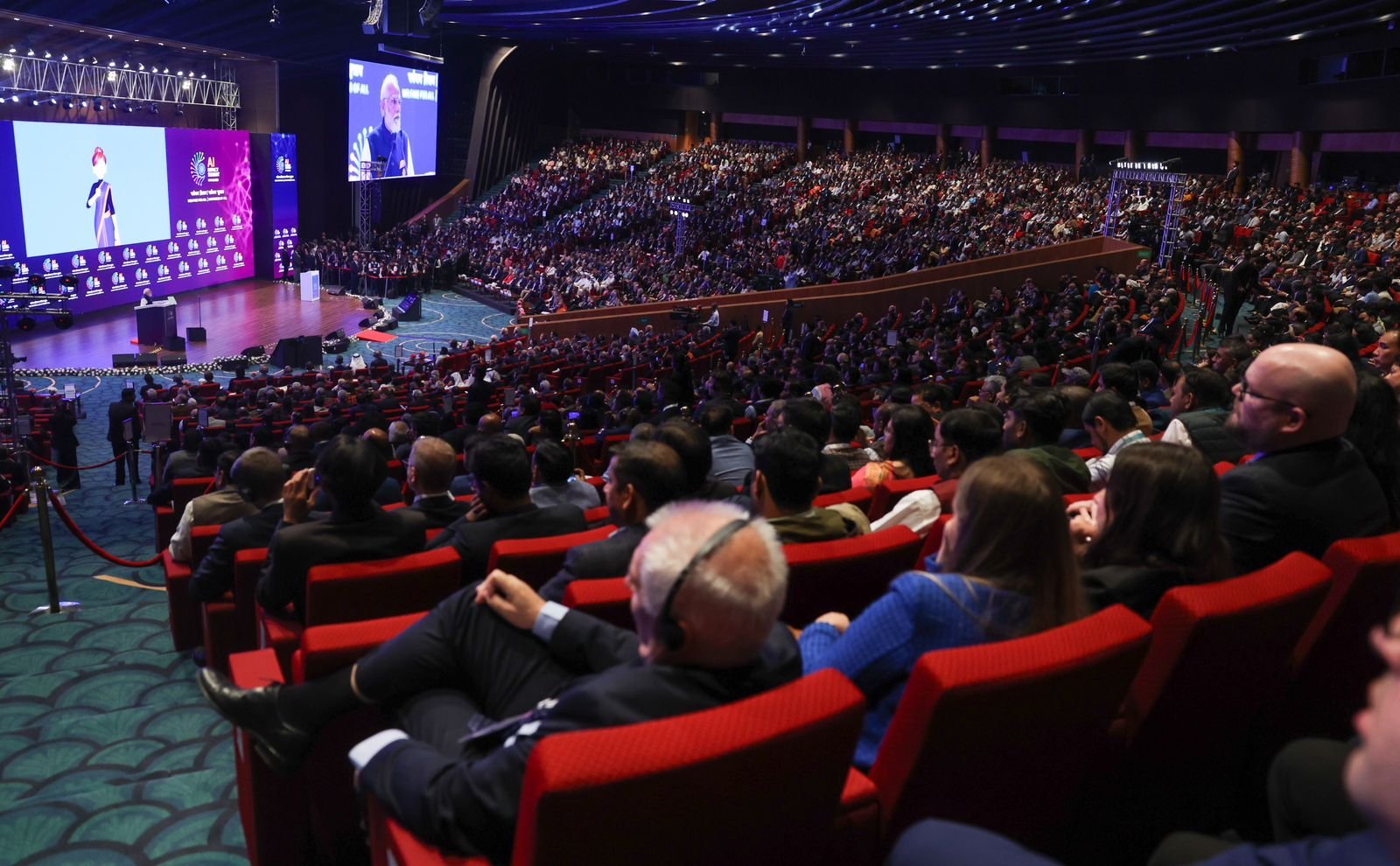
Prime Minister Narendra Modi inaugurated the India AI Impact Summit 2026 at Bharat Mandapam in New Delhi today. Addressing the gathering on the occasion, Modi remarked that the world’s largest and historic AI Impact Summit is being held in India, a nation representing one-sixth of humanity. He highlighted that India is home to the world’s largest youth population, the biggest tech talent pool, and a thriving tech-enabled ecosystem. He emphasized that India not only creates new technologies but also adopts them at an unprecedented pace.
The Prime Minister noted that 140 crore Indians are eager to embrace new technologies and, on their behalf, he extended a warm welcome to Heads of Governments, leaders of the global AI ecosystem, and innovators participating in the summit. He expressed gratitude for their presence and underlined that hosting this summit in India is a matter of pride not only for the country but also for the entire Global South.
Pointing out that the summit has brought together the “who’s who” of the AI world, with representation from over 100 countries and distinguished participants from across the globe, taking its success to new heights, Modi highlighted the strong presence of the young generation at the summit, which he said instills new confidence. He observed that while new technologies often face initial skepticism, the speed and trust with which the youth worldwide are accepting AI, taking ownership of it, and using it, is unprecedented.
The Prime Minister also remarked on the enthusiasm surrounding the AI Summit’s exhibition, particularly the large participation of young talent. He highlighted that solutions presented in areas such as agriculture, security, assistance for divyangjan, and meeting the needs of multilingual populations reflect the strength of ‘Made in India’ and showcase India’s innovative capabilities in the AI field.
Prime Minister remarked that in human history, every few centuries a turning point emerges that resets the direction of civilization. He highlighted that such moments change the pace of development and transform paradigms of thinking, understanding, and working. He observed that during such periods of transformation, the true impact is often not immediately understood. He recalled that when sparks were first generated from stones, no one imagined that the same spark would become the foundation of civilization.
Modi noted that when spoken language was first converted into script, no one realized that written knowledge would become the backbone of future systems. He further remarked that when signals were first transmitted wirelessly, no one could have imagined that one day the entire world would be connected in real time.
“Artificial Intelligence represents a transformation of the same magnitude as historic turning points in human civilization”, remarked Modi, highlighting that what is being seen and predicted today are only the initial signs of its impact. He stated that AI is making machines intelligent, but more importantly, it is multiplying human capability many times over. The Prime Minister emphasized that the difference this time lies in the unprecedented speed and unexpected scale. He noted that earlier, the impact of technology took decades to manifest, but today, the journey from machine learning to learning machines is fast, deep, and wide. He underlined that this requires a larger vision and equally greater responsibility.
Modi stressed that along with the present generation, there must also be concern about the form of AI that will be handed over to future generations. He remarked that the real question is not what AI can do in the future, but what humanity chooses to do with AI in the present.
Drawing parallels with nuclear power, the Prime Minister noted that humanity has witnessed both its destructive potential and its positive contributions. He asserted that AI too is a transformative power—if directionless, it leads to disruption, but with the right direction, it becomes a solution.
Modi highlighted that the core purpose of the Global AI Impact Summit is to deliberate on how AI can be made human-centric rather than machine-centric, and how it can be made sensitive and responsible.
Prime Minister Modi remarked that India’s vision for AI is clearly reflected in the theme of the summit— ‘Sarvajan Hitaya, Sarvajan Sukhaya’—Welfare for all, Happiness of all. He emphasized that this is the benchmark for India. He cautioned that humans must not become mere data points or raw material for AI, and therefore AI must be democratized. He highlighted that AI should serve as a medium of inclusion and empowerment, especially in the Global South.
The Prime Minister stated that AI must be given an open sky, while command must remain in human hands. He compared this to GPS, which suggests the route but leaves the final decision to the user. He underlined that the direction in which humanity takes AI today will determine the future.
At the New Delhi AI Impact Summit, the Prime Minister presented India’s M.A.N.A.V. Vision for AI. He explained that M.A.N.A.V. stands for:
• M – Moral and Ethical Systems: AI must be based on ethical guidelines.
• A – Accountable Governance: Transparent rules and robust oversight.
• N – National Sovereignty: Data belongs to its rightful owner.
• A – Accessible and Inclusive: AI must not be a monopoly, but a multiplier.
• V – Valid and Legitimate: AI must be lawful and verifiable.
He asserted that India’s M.A.N.A.V. Vision will become a crucial link for humanity’s welfare in the AI-driven world of the 21st century.
Prime Minister Modi remarked that decades ago, when the internet began, no one could imagine how many jobs it would create. He highlighted that the same is true for AI today, as it is difficult to predict what kinds of jobs will emerge in the future. He emphasized that the future of work in AI is not pre-defined, but will depend on collective decisions and actions.
Modi stated that the future of work is a new opportunity, marking an era where humans and intelligent systems co-create, co-work, and co-evolve. He underlined that AI will make work smarter, more efficient, and more impactful, enabling better design, faster building, and improved decision-making.
Modi noted that AI will also open higher-value, creative, and meaningful roles for more people, creating opportunities for innovation, entrepreneurship, and new industries. He stressed the importance of making skilling, reskilling, and lifelong learning a mass movement.
Asserting that the future of work will be inclusive, trusted, and human-centric, the Prime Minister remarked that if humanity moves forward together, Artificial Intelligence will elevate human potential to new heights.
Prime Minister remarked that transparency is the greatest safeguard, noting the saying “Sunlight is the best disinfectant.” He observed that while some countries and companies consider AI a strategic asset to be developed confidentially, India believes AI will benefit the world only when it is shared. He emphasized that open code and shared development will allow millions of young minds to make AI better and safer. He called for a collective resolve to develop AI as a Global Common Good.
Highlighting the urgent need for global standards, the Prime Minister pointed out that deepfakes and fabricated content are destabilizing open societies. Drawing a parallel with nutrition labels on food, he said that digital content too must carry authenticity labels so people can distinguish between real and AI-generated material.
Modi underlined the growing need for watermarking and clear source standards as AI increasingly generates text, images, and videos, stressing that trust must be built into technology from the start.
Emphasising the importance of child safety, the Prime Minister stated that just as school syllabi are curated, the AI space must also be child-safe and family-guided. He remarked that today there are two kinds of people—those who see fear in AI and those who see fortune. He asserted that India sees fortune and future in AI, backed by talent, energy capacity, and policy clarity.
Modi expressed happiness that three Indian companies have launched their AI models and apps during the summit. He said these models reflect the talent of India’s youth and showcase the depth and diversity of solutions that India is contributing to the global AI landscape.
Prime Minister Modi remarked that India is building a resilient ecosystem ranging from semiconductors and chip-making to quantum computing. He highlighted that secure data centers, a strong IT backbone, and a dynamic startup ecosystem make India a natural hub for affordable, scalable, and secure AI solutions.
Modi emphasized that India possesses diversity, demography, and democracy. He noted that any AI model that succeeds in India can be deployed globally. He extended an invitation to the world with the call: ‘Design and Develop in India. Deliver to the World. Deliver to Humanity’. He concluded by conveying his best wishes to all participants.