
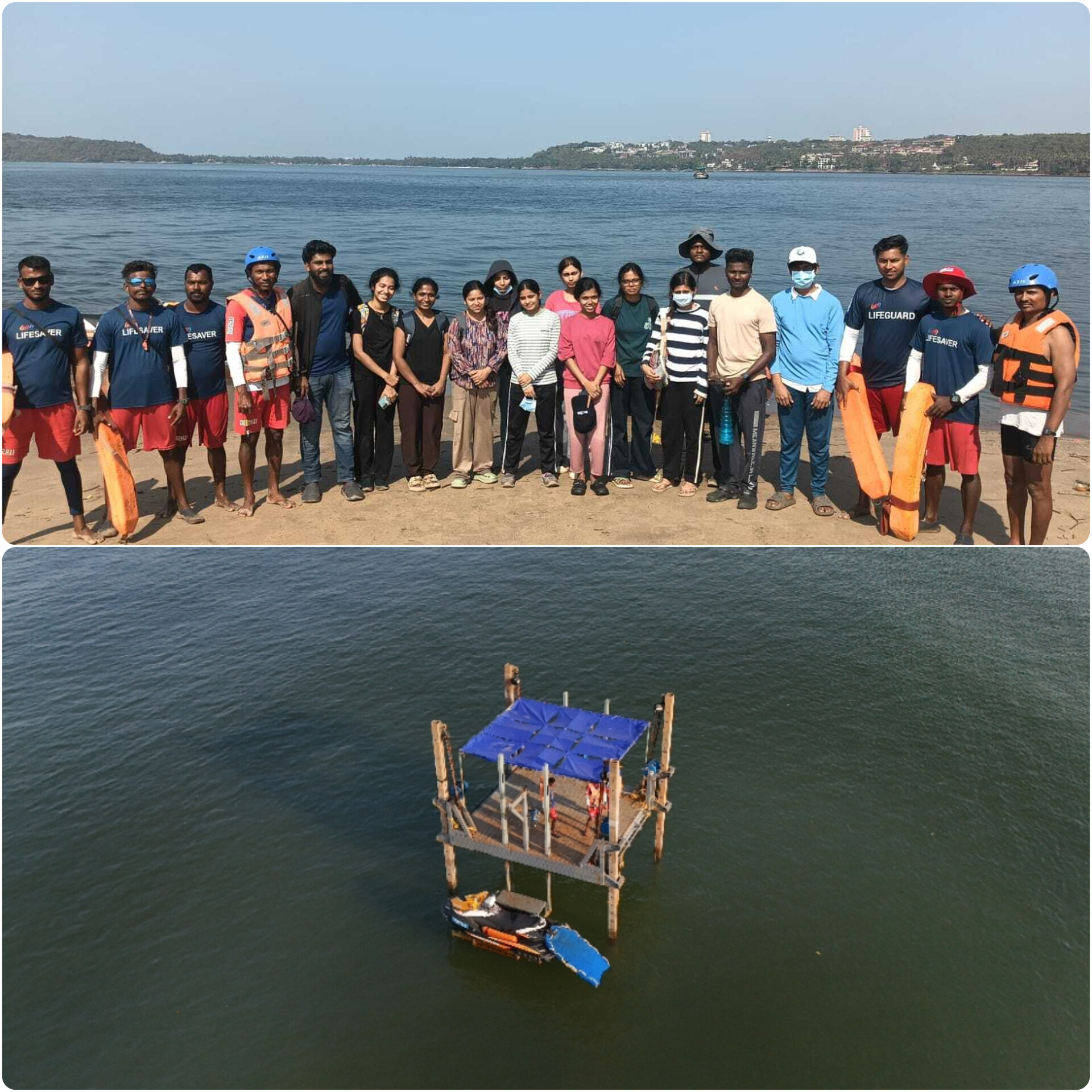
Goa government-appointed lifesaving agency, Drishti Marine’s newly deployed floating Seahorse platform, played a key role in the safe rescue of 13 students from the Dona Paula-based National Institute of Oceanography after a fishing trawler they were travelling in ran aground on a sandbar around 200 metres off Miramar beach on Tuesday morning, triggering panic among those onboard.
The rescue operation was launched directly from the Seahorse platform stationed off Miramar beach. The temporary floating station, designed to reduce response time during water-based emergencies, enabled lifesavers to assess the situation and initiate rescue efforts without delay.
The incident occurred at around 10.15 am on Tuesday (January 13), when lifesaver captain Shahish Ballikar spotted the stationary trawler, which was overcrowded beyond normal fishing capacity. Shahish, along with lifesaver Swapnil Khandolkar, immediately launched a jet ski from the Seahorse platform off Miramar beach to reach the trawler and assess the situation. The trawler crew requested assistance. Operators of a nearby trawler were asked to tow the grounded vessel using a rope, but the rope snapped during the initial attempt.
As anxiety grew among the students stranded onboard, Drishti Marine deployed a Rigid Inflatable Boat (RIB) in addition to the jet ski to evacuate the occupants safely. All 13 students, including nine females and four males, were rescued from the stranded trawler and brought ashore without injury.
According to lifesaver Swapnil Khandolkar, who was a part of the rescue team, they had spotted the trawler grounded on a sandbar during low tide and distress signals from a nearby boat. The early rescue attempt had failed as the towing rope snapped. “We immediately shifted focus to evacuation. All 13 students were provided with safety gear and safely transported ashore in a Drishti Marine rescue boat,” said Khandolkar.
Ahead of the festive season, Drishti Marine had deployed four floating Seahorse platforms at high-footfall beaches, including Calangute, Candolim and Miramar in North Goa and Baina in South Goa, to strengthen vigilance along the coastline.
The temporary floating stations allow lifesavers to monitor swimmers and beachgoers from vantage points at sea and respond more quickly to water-based emergencies. Once floated to a desired location, Seahorse is stabilised by four legs, each approximately six metres long, which are anchored into the seabed. Depending on depth and tidal conditions, the platform can be positioned 20 to 30 metres from the shore.
The Seahorse is one more addition to the list of unique, innovative beach initiatives that includes AI-powered bots to maintain vigilance and aid public order, a paw squad tapping into the potential of trained canines for beach safety and Sagar Safar, a guided sea-swimming experience where Drishti Marine lifesavers take beachgoers into the water, helping them understand sea conditions, beach flags and safe swimming practices.