
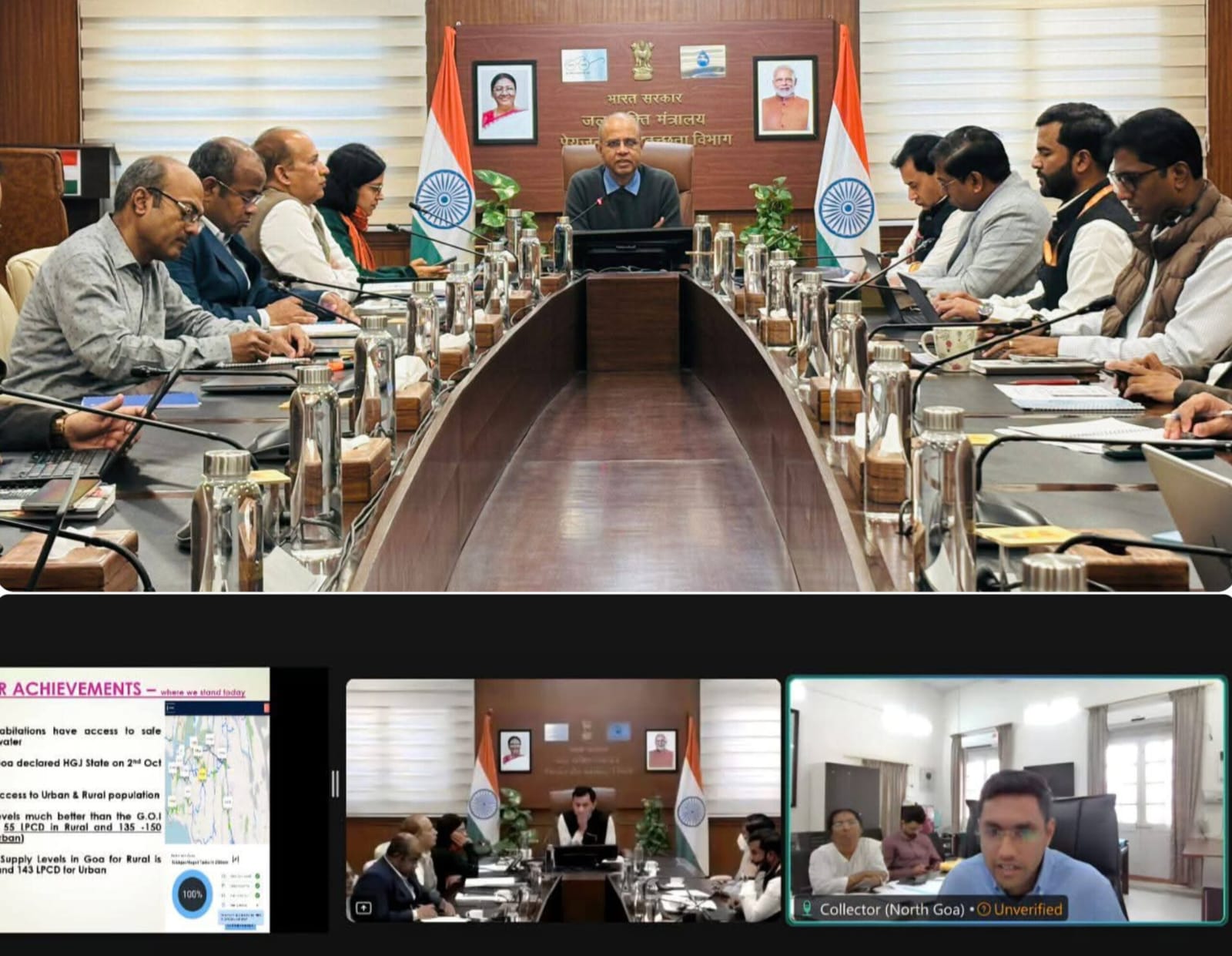
The Department of Drinking Water & Sanitation (DDWS), Ministry of Jal Shakti, organised the 6th edition of the District Collectors’ Peyjal Samvad today, bringing together senior officials, district administrations, and sector experts to deliberate on strengthening the implementation of Har Ghar Jal under the Jal Jeevan Mission (JJM). The virtual event was chaired by Ashok K. K. Meena, Secretary, DDWS, and witnessed participation from District Collector/Deputy Magistrate/ District Officials across the country.
In his address, Secretary, DDWS, Ashok K.K. Meena highlighted the Mission’s journey since launch of Jal Jeevan Mission in 2019 and noted the significant progress achieved by States over the past six years despite the constraints. He emphasized that while the initial years focused on rapid asset creation, the Mission has now entered a crucial phase of transitioning towards community‑owned and community‑managed rural water service delivery, an approach that is central to strengthening long‑term functionality and service quality.
Underscoring the pivotal role of District Collectors in steering this shift, he stressed the importance of systematic handover of schemes to Gram Panchayats, in line with constitutional provisions, and the need to ensure that communities assume full ownership of operations and maintenance. Referring to encouraging examples from various States, including 24×7 systems successfully managed by Gram Panchayats and strong leadership demonstrated by women Sarpanches, he said that these models reflect the growing strength of local governance in the water sector. He informed about the forthcoming extension of Jal Jeevan Mission, which will prioritize saturation of single‑village schemes, expansion of solar‑based infrastructure, comprehensive asset mapping through PM Gati Shakti, creation of a unified scheme database, and financial reconciliation to enhance transparency.
He urged all districts to accelerate scheme handovers, strengthen community‑led processes under Rajya Jal Utsav and Lok Jal Utsav, and intensify efforts to ensure sustainable service delivery, reaffirming the commitment to achieving the vision of safe, adequate drinking water for every rural household.
Ankita Chakraborty, Deputy Secretary – NJJM, welcomed Secretary-DDWS, Additional Secretary and Mission Director – NJJM, Mission Directors from States and all participating District Collectors/ District Magistrates to the 6th District Collectors’ Peyjal Samvad. She congratulated the districts whose initiatives were selected for presentation, noting that their efforts are contributing to a growing national repository of best practices in rural water service delivery. She highlighted that the Samvad serves as a platform for peer learning and exchange of innovative ideas, underscoring that districts are the fulcrum where policies translate into outcomes and community-led approaches shape sustainable systems. Referring to the days’ focus on Jal Utsav-Jal Mahotsav, she emphasised the shift towards community-owned and managed rural water services, and the pivotal role of district leadership in ensuring service quality, convergence, and citizen engagement.
DDWS Presentation on Jal Utsav-Jal Mahotsav
A detailed presentation on Jal Utsav-Jal Mahotsav was made by Y.K Singh, Director, NJJM. During the session he brought out that Jal Utsav will function as a multi-tiered public engagement framework to strengthen water sustainability as a people-led movement. He explained that the initiative seeks to reconnect water with local culture, traditions, and community experience, transforming conservation and sustainable use into a cultural expression anchored at the grassroots. He informed that Jal Utsav will be celebrated through three verticals –
- Jal Mahotsav at the National level,
- Rajya Jal Utsav at the State/UT level, and
- Lok Jal Utsav at the Gram Panchayat level.
The national Jal Mahotsav will be observed from 8th to 22nd March, coinciding with International Women’s Day and culminating on World Water Day, with participation across all levels. States and Union Territories have been encouraged to organise Rajya Jal Utsav in alignment with their local context and timelines. At the village level, Lok Jal Utsav will be shaped by local customs, water-related traditions, and cultural practices, ensuring that celebrations reflect community identity.
He highlighted that Gram Panchayats are to prepare Lok Jal Utsav calendars, allowing local events to be integrated into the overarching Jal Utsav framework. He emphasised that while the national Jal Mahotsav follows a fixed window, States and Gram Panchayats have been provided full flexibility to celebrate their respective Jal Utsavs according to local traditions and seasonal patterns. He reiterated that Jal Utsav is not a centrally imposed programme, but a decentralised, culturally rooted, community-driven celebration to strengthen public participation under Jal Jeevan Mission.
District Presentations
Districts including North Goa presented their progress and field practices. Each presentation was delivered by the respective District Collector/ Deputy Commissioner/ District Officials. North Goa, Goa: Ankit Yadav, District Collector & Magistrate presented the district’s technology‑enabled model for inclusive drinking water service delivery. Goa has achieved 100% household access to safe drinking water and was declared Har Ghar Jal in October 2020. The district provides metered functional tap connections to every household, ensuring uniform coverage across rural and urban areas. North Goa has adopted fully digital, real‑time billing supported by QR‑code enabled payments. North Goa is now transitioning toward a Smart Water Utility, introducing IoT‑based real‑time monitoring, SCADA integration for WTPs and STPs, and a unified mobile application offering citizen-centric services such as billing, leak reporting, new connections, and grievance redressal. These initiatives underscore the district’s focus on modern, efficient, and accessible water governance.